Tuesday, 18 October 2016

South Africa - Vignettes of the Cape in Spring


South Africa is a multi-hued country, colourful in every sense of the word, it is beautiful everywhere and in all seasons, but my favourite is spring in the Cape. Flowers bursting in a riot of colour with dainty birds sipping nectar. These pictures are a glimpse of the views that you have to look for.
The protea
The king protea is the national flower of South Africa and at this time of the year it is blooming everywhere, huge and colourful.  There are many varieties of protea, some so different in shape and size, however all are colourful and pretty.


Flowers Flowers Everywhere
Nothing strikes you so much as the profusion of flowers and nowhere more than at the West Coast National Park. A part of this park, Postberg, is open for two months only, August - September during which it is a breathtaking palette of colour.  We went on the last few days and only the yellow remained, but  literally in carpets. 
Waves lash the shore
The WCNP offers some spectacular seascapes too, raw rocky beaches being lashed by the violent Atlantic and the placid Langebaan Lagoon, with its varied palette of blues.  There is an island here which is the refuge of thousands of seals and with a pair of binoculars one can see them.  The violence of the Atlantic made the west coast the terror of sailors in the days of sail and north of here lies the dreaded Skeleton Coast of yore.
Wine labelled with the National flower
A little distance out of Cape Town is the Paarl Valley, one of the premier wine growing areas of  famous wines of South Africa. In this area, there are towns like Franschhoek, Paarl, Stellenbosch, all surrounded by vineyards. there is a distinct French flavour to many of these areas, perhaps that's how the wine industry took off.
Kirstenbosch with Castle Rock standing sentinel
A botanical garden established by Cecil John Rhodes on the apron of Table Mountain, is the repository of much South African flora and some exotics as well. Beautifully laid out and colourful in spring, it offers a tranquil but educative walk amidst flowers and birds of various hues. Castle Rock is a part of the Table Mountain massif.
Mandela's Gold
In a tribute to the iconic Nelson Mandela, this golden coloured Bird of Paradise is carefully bred at Kirstenbosch.  The more common flower too grows in profusion here.
Sipping Nectar
A brilliantly coloured sunbird sips nectar from a variety of protea at Kirstenbosch.  There are many birds at Kirstenbosch, some are semi-tame like species of guinea fowl, ducks, geese and spur fowl.  Then there are birds like these, flitting among the bushes and enjoying the flowers.  A certain tree has been home to generations of spotted eagle owl, and not to disappoint we saw the mother sitting over her brood.
A craftsman's hands
Stone carving is a popular handicraft, various stones, particularly this variety of grey stone is carved then oiled for a lovely play on shades of black and gray. Subjects range from the traditional to the modern. Handicrafts in the Cape, are very meticulously wrought with great attention to detail and finish. 
Life in Stone
Artisans chisel the stone rapidly, but surely, a slip or mistake can ruin a large block.Statues of animals, people and activities; statues in a variety of stone; statues of realistic figures and abstracts; there is a wide variety here.  They offer to ship large pieces to one's home country.  Mostly the work has meticulous attention to detail and finely finished.
A Loving Couple
On our way to the Cape of Good Hope we stopped at Red Rock Tribal area which has a delightful restaurant run by this very friendly couple.  The small and very meticulously laid out dining area is made of wood with vines on the outside walls; very redolent of old residences.The pastries, Coffee and tea were absolutely delicious.
Friendly....
One of the ladies attending to us in the Red Rock Tribal area was this pretty girl. She had her hair tediously knotted into tiny knots and exactly arranged.  She graciously allowed me to take pictures, chatting away all the while. The most of the ladies have interesting hair arrangements.
Franschhoek Motor Museum
Located between Paarl and Franschhoek, the FMM has an eclectic mix of cars.  Ranging from a Model T Ford and Lorraine Dietrich from 1911 to modern Ferrari's; tourers, sportsters, formula 1, shooting brakes all make for a breathtaking range of cars.  Worth a visit by any car buff, by anybody for that matter.

The iconic Table Mountain
the best place to see the breath-taking views of Cape Town is from Table Mountain. It has a cable car to go up, but for the intrepid there are many routes to climb up on foot. These are interesting trails that allow one to see the different views and flora as one climbs.  There are climbs for the beginner and for the technical expert.  However none of the trails are a casual walk so be prepared with adequate water (at least two litres per person on a hot day); and a jacket for the considerable change in temperature from a warm bottom (pun intended) to a windy and cold top. Please see my earlier blog on  walking up Table Mountain

Cable car to the top...
For the easy going or the not-so-fit or for those in a hurry there is a cable car to the top. The hitch is that the Mountain creates its own weather system which is often uncongenial to go up in.  Strong winds, poor visibility (the 'tablecloth' of cloud) and bitter cold can prevent one from going up and enjoying the views. On sunny days the wait for a ride in the cable car can be upto two hours, book online to half the wait time. Timing and planning is critical for Table Mountain.
On top...
 Once at the top one is rewarded with beautiful views and seacapes, there are palettes of blue punctuated with cotton fluff white in the water and the sky. Take an easy walk to the highest point on the Mountain, Maclears Beacon.
The Lighthouse atop Cape Point
Cape Point is the south west most point of the continent, a promontory with a well established tourist facility with views all around.  The seascapes are vast and ever changing in shades of blue, from a pale sky-blue to the deep-blue bruises of deep water. 
The weather is ever variable and white wisps sailing through a pristinely blue sky can change suddenly to glowering clouds and rain, so be prepared. The drive to Cape point is through a National Park and along the way one can see baboons, ostrich and varieties of antelope.
The art of Dylan Lewis
One of the more well known sculptors of South Africa, his work on display is mainly African animals and surrealistic human figures portraying "the animal within". His work is displayed at a sculpture garden in Stellenbosch where he has placed pieces amidst natural surroundings, worth a visit to walk the large estate. His animals are very accurately represented, with a lot of fluidity and action.

Protea buds
South Africa is spectacular, scenic, uncertain weather, colourful flowers and birds; and the Cape more than most places.  If one likes history, scenic panoramas, seascapes, flora and fauna; the Cape is for you.  Doing it as a tourist with a been there and done it agenda is not the best way, perhaps long walks and drives to soak in the scenery, watch the wondrous flora and fauna and soak in the turbulent and often violent history of the land.

Saturday, 30 July 2016

Off the beaten path at Hogenakkal Falls


Hogenakkal Falls
About180 km from Bangalore, the falls are a attractive tourist draw. Though the falls are not spectacular in themselves,  they have spawned an entire tourist industry around.  Of course as we are always wont to believe, the waters are holy, hence a dip in the falls is mandatory to cleanse one of accumulated sin.  Though a sceptic like me prefers sin to disease that the garbage in the water is likely to spread. The waters of the Cauvery, flow through two sets of falls here, a smaller one close to the touristy places and this gorge a little way in.


The Upper Falls
These falls are closer to Hogenakkal, here there is a complete tourist/religious township. The railing on the right is where religious are to wash off their sins.  Are those sins I see festooned on the railings?


The Coracle
This is the main form of water transport here.  A frame of split bamboo/cane covered by blue plastic and coated in black tar. Steered by a single oar it is also the only means of propulsion. Our boatman, very deftly rowed and steered up current, no mean feat. The coracle, about 7 feet in diameter, can carry 8 or 10 people; we went in this one to the lower falls in the gorge. 


Cooking al-fresco
Old coracles are re-purposed by using them as roofs of huts and outdoor cooking shelters.  Apart from the myriad tourist industries that such places have over here the Falls have engendered coracle boatmen, massage-men, fisher folk and fruit sellers.   Here a group of men and women cook a quick lunch while others carry on with the business of the day.

Fish Seller
There is a bustling fish market here,the speciality being fish fried in a masala unique to this place. Many people buy, the often live, fish and have it cleaned and marinated to take home.  From the variety and size of fish, it is obvious that the fish is not all from this river and much of it comes from elsewhere. The fact that the fish are fresh is evident from the many live fish,like the one here held by the seller.

Fried Fish
Some people buy fresh fish and take it home, and some like eating it hot and fried here itself. A couple doing brisk business selling various varieties of fresh fried fish.  Some of the fish are bony and some are not, the bony fish appear to be tastier but more difficult to eat.

Ladies Selling Cut Fruit and Pickled Mangoes
 All business activity is quite a social affair, as we see from the two friends here running a chat while selling cut fruit. Markets in India are actually very social affairs, where selling, bargaining and buying are part of an elaborate ritual  
Cut Fruit by the Glass A brisk business here, cut seasonal fruit are sold by the glass.Here is  a closer view of the cut fruit, pineapples, watermelons and mangoes. The mangoes appear to be pickled in a manner that they can be eaten as fruit rather than a condiment. 


Water pots by the village tap
Though a common sight, over here the traditional brass  has given way to bright coloured plastic as seen by these neon coloured pots by the village tap.

Aayenaar
These Aayenaars are said to be the  the guardians of the village, in some villages they are simple but in many, such as the one in Pennagaram here, they are huge, colourful and complex.  At one end of a cement platform, the entire Aayenaar has, for good measure a representative of many forces. Apart from the stern and martial deity in the centre, there are effigies of policemen, horses, a tribal male and not mistaking the graphic anatomy, a tribal female.

Rajarajeshwar  Temple
A huge edifice in Bangalore, the colourful temple towers over much of the surrounding trees and houses.  As with all temples here, it has elaborate and colourful  figures adorning the walls, very painstakingly made. 


Sunday, 5 June 2016

In the Land of My Forefathers - Behind the Tourist Iran


This is my second visit to the land of my forefathers, I was first posted there in 1990 as a Major of the Indian Army on deputation to the UN.  At that time Iran had just emerged from an eight year war with Iraq and the strict rigours of the revolution were in force. Twenty six years later I visited a very different Iran, beautiful, weary from years of sanctions yet keenly progressive.  This photoblog is not a chronicle of my trip nor is it a travelogue. It is not a compendium of tourist sites and their photos, there millions on the net.  Here I have tried to impart some flavour of what I saw and felt.

Leaving 'Bombay' With 'Madras' further south.  
The place names haven't changed in the map display.  Many years of sanctions and isolation
have left their mark on many aspects of Iran, 
the aircraft, hotels, cars, all require substantial modernisation.
Urban sprawl
Tehran is a large city, about 16 million people live in 700 sq km. The size of the
sprawl is indicated by this picture from a cable car going up the Alborz Mountains
that surround Tehran. This cable car, at 6.5 km,  is one of the longest in the world and
the views from the upper stations are breathtaking.

A Parsi Zoroastrian Jashan at Mount Damavand
High up in the Zagros Mountains near Tehran stands Mount Damavand.
This mountain, Iran's highest at about 19000 feet, is deeply linked to Zoroastrian lore
and every Parsi pilgrimage has a religious Jashan  ceremony here. Due to an unexpected
road diversion, our outward journey was increased to five hours instead of the usual two.
Unexpectedly this diversion enabled us a treat of some of the most spectacular scenery
I have seen by the road. 
Farohar above the door at Peer-e-Banu
An ubiquitous symbol, the Farohar adorns religious places, hotels, government establishments,
ancient and modern scripts. Considering that it has possibly been adapted from ancient
 Egyptian or Mesopotamian scripts and used by the ancient Achaemenids only, it has gained
remarkable popularity. Many Parsi Zoroastrians in India too sport a
Farohar sticker on the rear windscreen of their cars. 
Blue Art
Most religious places in Iran have exquisite paintings adorning the walls as this
particularly intricate example of the art in the Mosque in Esfahan shows. The
base colour is almost always in different shades of blue.
Signs of the Times - War
Iran fought a long war with Iraq in the 80's, arguably a million people died
 in this prolonged conflict.There are signs of the Hero everywhere, some are
 likenesses of local martyrs  and some are morale boosters as this one is. 
 In all cases the artwork is meticulously executed with 
remarkably accurate likenesses.
 Signs of Present Times - Peace
Gradually war Heros are giving way to modern industrial and vocational heros.
Iranians put much store by the art on building walls and billboards.  Most blank walls
of buildings are adorned by such paintings.
Total Concentration
Meticulous craftsmanship is a matter of great pride. Handicrafts, no matter how
small or cheap are almost always well made and presented. There is nothing crude
about the cheapest work.  In another show of pride, most work is invariably signed by
the artisan.
The Grand Bazar
A vast market that deals in a large variety of goods.  With a cavernous interior,
it has a myriad lanes, each area specialising in a particular type of wares. The Grand Bazar
here is typical of most such ancient bazars in the middle East and Turkey.
Dry Fruits
Iran is flush with dry fruits and the Grand Bazar is no exception. There is
an entire area of the bazar that has only dry fruit sellers. Apart from the usual nuts;
there are many very typical Iranian offerings, exotic berries and and aromatic spices.
The locals love their fresh fruit juices and there are many stalls selling
freshly pressed fruit and vegetable juices.  I was refreshed by frothy and sweet
carrot juice.
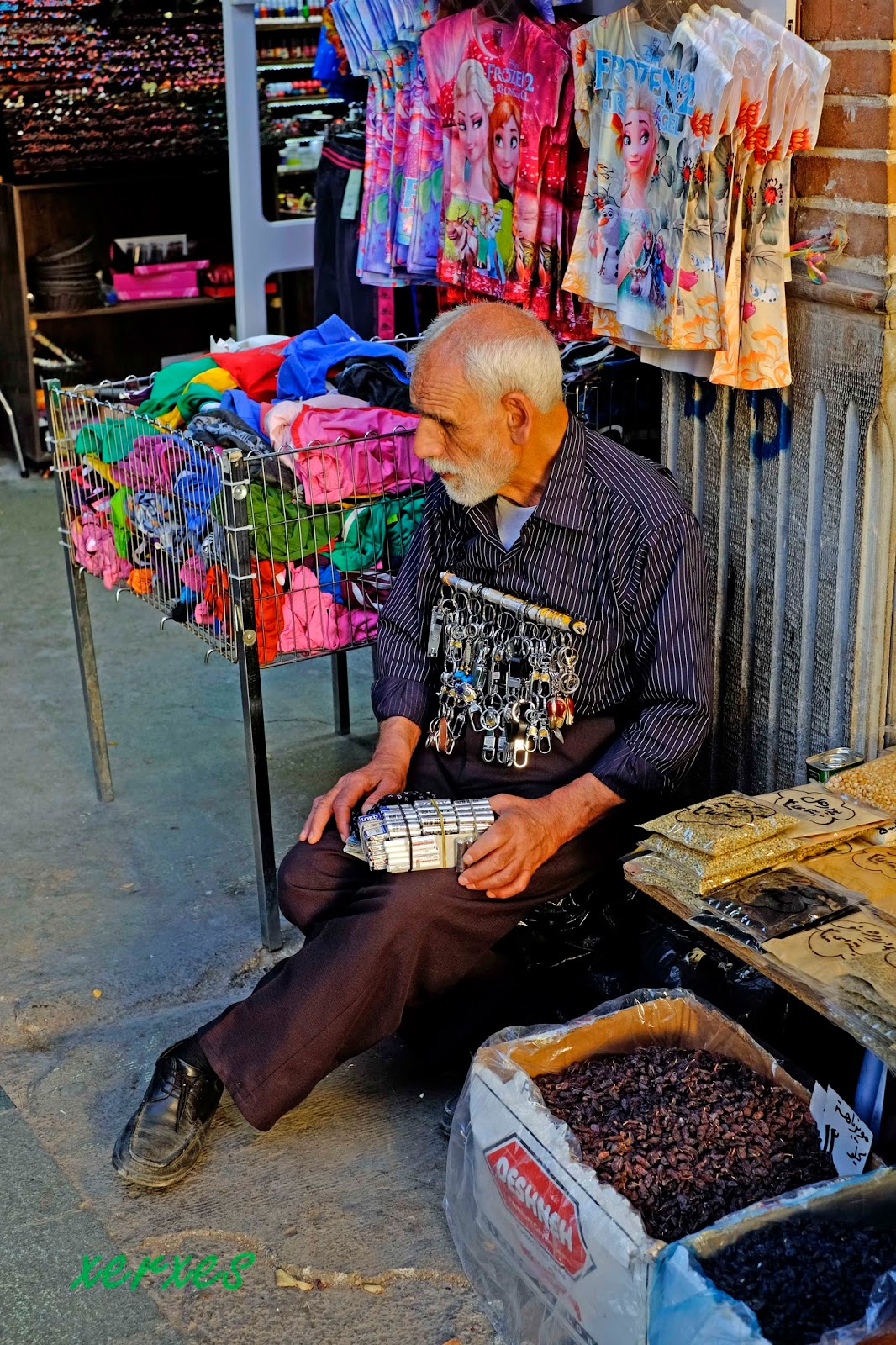
Multi-Tasking at the Bazar
This venerable gentleman is selling T-shirts,  frocks, keychains (around his neck),
 batteries (in his hand), berries and spices.  I was told that Iranians are too proud to beg
and that everyone, no matter how poor, tries to earn a living.
Carpet at the Niavaran Palace
Notice the picture of Napoleon woven into the carpet, and that's possibly Victoria next to him.
The Pahlavis, the last royal dynasty of Iran, built the Palace and it is abrim with opulent presents from
other royal houses the world over. This vast and intricately woven carpet has royal likenesses from
 the ancient Persians, the Iranian rulers and most major European royal houses.
Roses
It was spring and everywhere there were lovely flowers. The local authorities
take great pains to ensure colourful blooms in all public spaces.
This delicately shaded rose was at the cable station.
Pansies
The riot of colour in the blooms were a delight to behold, like these pansies
in a public garden. Every public space, every vacant plot, every road median,
everywhere there are blooms and colour.

Two Zoroastrian Ladies
The two ladies are engrossed in the tale being narrated by the Indian Parsi priest
inside the Peer-e-Banu Shrine.  Iran has moved forward in leaps and bounds
since the revolution and war. The lady on the right is dressed traditionally and is
from the family of caretakers here; the lady on the left came from Yazd to help
and her modern dressing shows.
Faredoon
Such a typical Parsi name, the old man from the Iranian Zoroastrian family charged with looking after
the Peer-e-Banu Shrine. Every loved him as was evident by the fact that he was
so much richer with the tips we all left him.
Ornate Art
Intricate designs are very popular, particularly in Esfahan, a lovely example would be this lift
shaft in a hotel. This is the reverse view but so beautifully
decorated, it is set amidst an equally ornate foyer.

Warning to motorists!!
At a police post on the highway was this smashed car set on a pedestal as
a warning to motorists of the dangers of speeding.
Abandoned Village
At isolated desert locations we visited ancient fires in tiny rooms. I would like to
believe that these were predominantly Zoroastrian villages, each with their holy fire.
The fire had to be concealed at oppressive times in history hence they are hidden in
tiny rooms.  The villages are now mostly abandoned. A very remarkable aspect of the
villages is that no matter how small or poor, they are immaculately clean .
A Zoroastrian lady
This lady typifies why many of the Zoroastrian villages are probably abandoned.
The youngsters migrate and ladies like this one have property in India and Iran, she shuttles
between the two countries.  She has a daughter in living in Dadar, Mumbai.
I met her in a village and she spoke fluent Gujarati and Persian.

Yazd Atash Kadeh (Atash Behram)
This is the highest form of place of Zoroastrian worship. There are eight Atash Behram in India
and only one, this one, outside India.  It is immaculately maintained, as are all
Zoroastrian places of worship.  I believe there is a rich Iranian Zoroastrian diaspora which
remits funds for the upkeep of religious places.