Wednesday, 21 September 2022

Lidderwat - We never got there

 "The world reveals itself to those who travel on foot" said Werner Herzog...  


...This is particularly true of the mountains, where beyond every bend in the track there is a new vista to enjoy. 
A friend, Basav, and I went to the Kashmir Valley, where we meandered our way to the Aru Valley.  Down this Valley flows the Lidder River, not too wide, but very powerful especially since we had gone just after the monsoon. 

The gorgeous Lidder River
As we approached the source of the river, the sides of the valley got steeper, the gorge got deeper and the river flowed more purposefully. It may have seemed placid, but as we looked carefully we could see the strong current.   Seemingly little rivulets swept whole trees and boulders from the hillside.

Looking for the source of the Lidder River
So Basav and I set out for Lidderwat, the source of the Lidder River,  we had been told that it was about three hours each way, with an hour for lunch there made it about a seven hour return trip; given my slower pace, maybe about eight hours? We started walking at 8 am and expected to be back by 4 pm, we couldn't have been more wrong.
Smiling and admiring the view when it was dry..... pic courtesy Basav

It was sunny and dry when we started out, though slushy in patches; we were told that it was always slushy at these places and that we needed to take a detour no problem, we walked around the slush. I had switched to a fanny pack for this hike, staying as light as possible for the long walk.  Unfairly I shoved those 'last moment' things into Basav's rucksack.
The track was boggy at places, that's Basav laughing at the bog...
The start was boggy and steep uphill, very steep; but only for about a kilometre, after that the terrain was lightly undulating all through, certain stretches remained very slushy, and the slush was deep enough to cover boots. Every bend in the track showed a different scene and the terrain was varied.  The scenery changed from bald craggy mountains to mountainsides with pine trees right down to the river.
Ranks of pine trees marching....

There were alpine meadows interspersed with deep, dark forests.  Here the canopy was so dense that we couldn't see the sky and no light came down.  There were bakarwals (goat and sheep herding nomadic tribes) that were preparing to go to lower altitudes for winter. They made tents of plastic sheets or rudimentary huts of mud and grass.
The track was steep and the trees were large age and old with Basav standing in front, he is not old but very tough.

Two groups caught up to us, but then they would stop, so we overtook them again, then we would stop..... These groups stayed with us, leafrogging our way forward.  They were going to camp the night at Lidderwat and we were to return and ominous portent of events to come.
...and then it started raining.  Thats a Bakerwal camp covered in plastic sheets at the bottom left. pic courtesy Basav.
It rained heavily for a while, then it continued to drizzle intermittently. The drizzle made the complete track wet and muddy. Nothing (except Basav's shoes!) would keep us completely dry.  
...gooey mud soon made our shoes weigh twice as much. pic courtesy Basav
The path was mucky, our clothes and boots were muddy and so at after about six kilometres, at 1200 hours we (basav and I) took the decision to return.  We had been walking for about four hours by then and had just asked the guide of one of the groups as to the distance to Lidderwat, he replied that it was about 10 km one way, so we had about four kilometres to go and 10 to return. 
...the slushy parts now joined to become muddier and deeper.  That's Basav having crossed the mud and not smiling so much any more. 
Before it rained, we were careful not to get our boots dirty, but the rain and exhaustion soon rid us of this notion and on the way back we were sloshing merrily through all but the deepest parts. Our hiking boots soon weighed more than the boots themselves. We ate packed lunch by the side of the track, admired the scenery and then continued walking.
A Bakerwal hut
Mules and horses made the path muddier, often they would sink deep in the muck.  The Bakerwals  on the other hand found/made tracks on the hillside, often where none existed.  These tracks were much easier to walk on, less boggy and our boots stayed cleaner. So we climbed higher up the hillside and followed these paths, finally coming down at the end.

A welcome cup of noodles, maggi is the generic name for any noodles
Having walked about 12 km, we were ravenous so we asked this gentleman to make us maggi-omlette, staple food in the mountains.  To our surprise he didn't know what that was and served us maggi noodles and omlettes separately, hungry as were were we happily wolfed it down. And as always chasing this down with cups of  Kahwa,  the Kashmiri tea.
 I am glad we turned around when we did, another fourteen km would have had us thrashing about in the dark, though we both had head torches, the fun would have gone out of the hike. So it was a nice fun long walk. That we walked another couple of kilometres to the river on the other side.... but that is another tale.
"A rainy day is the perfect time for a walk in the woods" said an intrepid adventurer Rachel Carson. But the one that fits this situation the best is a quote by an unknown hiker "I'd rather be hiking in the rain, than sitting indoors at a desk on a sunny day"


Tuesday, 23 August 2022

Junk That Expensive "breathable" Jacket


It is raining buckets as I climb, there is no shelter nearby, so I continue upward and forward, drenched to the skin. I am wearing a 'Waterproof and breathable' outfit, a poncho, waterproof over-trousers, waterproof boots and a waterproof hat. The gear keeps me dry for all of fifteen minutes till I feel the first trickle of ice-cold water or is it sweat?  This scene has played out for me on almost every hike I have done.
At the Sarovar at Hemkund Sahib, in a "waterproof" jacket
They say that the pores of these tightly knit fabrics with a special layer for breathability, are too small for water molecules to penetrate (read rain), but large enough to allow water vapor (sweat) to pass through. But every time I have worn a "breathable" garment I have got wet, seriously wet.  I have invested a lot of money in every conceivable brand of waterproof and breathable fabric, even expensive brands have not kept me dry. 
Soaked on the way to Tungnath, that's a "breathable" poncho I am wearing
This is, I think, because they say, that the sweat vapor stays in the (steamy) vapor state till it exits the "breathable" fabric.  However once it reaches the inside surface of clothing which is cooler than body heat the vapor will condense and the inside surface of the rain garment will become wet with sweat.  Though most times what I think is actually happening is that the sweat vapour is drying on the surface of the skin. For sweat to actually move through the fabric that has been made "waterproof and breathable"  there would need to be an airflow warm enough to keep the sweat in a vapor state till it goes out of the fabric. 

This situation seems to be made worse in the warm, wet Indian climate, where the humidity and rainfall is such that waterproof fabrics simply give up. So I had this "waterproof and breathable" poncho and I wore it twice, once when climbing up Tungnath and once in Matheran. The poncho became slick and gooey, I suspect the waterproof layer was coming off. It got so sticky that I had to finally discard it. I Have tried such garments in the mountains and in the plains with nearly the same results.
In the Valley of Flowers wearing a waterproof and breathable Jacket, and waterproof shoes, none of these kept me dry 
In my opinion, spend small money on a rain garment at a local store, use it for a season or two and discard it.  Buy a cheap poncho that allows air circulation when climbing, that is likely to keep one dry more than any breathable jacket. If the breeze is too much, tie a cord like a belt around the poncho, it doest fly.  That, at any rate, is what I do. It may be better for a fabric to dry fast, which waterproof garments, particularly shoes, do not do. Read many blogs on mesh vs waterproof trail running or hiking shoes and you will understand what I mean.

 I have found that a quick or stay dry type of fabric, particularly in hiking pants (trackpants) tend to dry very fast. Spend a little more money on stretchy and thin trackpants they are worth it.

"There's a hole in the bucket....."

Thursday, 11 August 2022

What Have They Done to this Fair Earth?

 As Jim Morrison sang:

What have they done to the earth, yeah?

What have they done to our fair sister?

Ravaged and plundered and ripped her and bit her

Stuck her with knives in the side of the dawn

And tied her with fences and dragged her down

Pine leaves on barbed wire at a friend's farm near Igatpuri
On many treks, most in fact, I find wire and construction rods in nature, dividing the land or marking "this is mine".
Mule train on the way to Ghangariya notice the orange wire
On pilgrimage routes, housing there's wire in different forms and colours, in snow bound areas in bound areas, bright orange so that presumably the wire can be seen against the snow. 
Cormorants on cables near Mumbai
The birds, animals and insects have grown used to this intrusion into their space and in some cases have adapted to these unusual perches.
Barn Swallow chicks on a wire near a house being constructed at Pangot
No matter how ecology is affected, the attitude of most humans is "Ecology is fine as a noble cause, but be sure it is not in my backyard".  
Bird on a electric cable in Chanfi
Witness the smartphones, flyovers and oodles of other progress, everyone knows that they are bad for nature but who will be the first to do away with them? 
A tree growing around barbed wire
Considering the recent Government ordinances in various countries on reining in consumption, one would think that such wires and "marks" of  advancement would be detrimental to nature.  
Barbed wire ends, but does it end?
But it seems business as usual for big corporates who make disposable goods so that you and I can have the "latest model." Impediments to this business causes inconvenience and delay, which you and I are not willing to countenance.
Construction bars bear mute testimony to the frantic pace at which "progress" is advancing
To quote Jim Morrison again:
This is the end, beautiful friend
This is the end, my only friend, the end
Of our elaborate plans, the end
Of everything that stands, the end
No safety or surprise, the end

Let this not be the end


Monday, 30 May 2022

Bharatpur: A Birders Paradise


“Photography is the story I fail to put into words.”

– Destin Sparks

In order to see birds, it is necessary to become part of the silence.”

-Robert Lynd 

A tranquil part of the Sanctuary
Birds, birds birds, the Bharatpur Bird Sanctuary is simply full of them, and going there on a weekday is that much more calm and serene.  

Telling each other secrets A pair of Rose-ringed Parakeets go about their circle of life while we look on...
A Grey Heron dries its feathers
Birds are one of the sure indicators of the environment, if they are in trouble, we know we’ll soon be in trouble. To see the one of largest gathering of migratory and resident birds in India, I went to Bharatpur Bird Sanctuary in the winter of this year. The Sanctuary is and was known by different names, but I like Bharatpur Bird Sanctuary and I shall call it variations of that.

A Black-winged Stilt contemplates its reflection in the small pool behind where I was staying
A long but lovely train ride from Mumbai deposited me the next midday at Bharatpur, it was too late to go to the Bird Sanctuary, so I did some local birding around the place I was staying.

Sarson (mustard) flowers everywhere one could see
It was lovely, the quiet and sounds of village life, of course punctuated by the electronic blare of modern times. At this time the fields were planted with sarso (mustard) and the yellow flowers of the ripening crop was like a carpet as far as eye could see.

A Grey Wagtail sits onthe rocks  in the village pond.
Over the next three days I took a guide (one day) and one of the ubiquitous cycle rickshaws, the same rickshaw person became my friend and guide, and we went around various parts of the park over three days.
one of the many rickshaws going along the trails that divide the wetland
At this time of year there are many birds and animals, many of them breeding and the young, like that of humans, are either raucous or quiet, shy or aggressive.  Each of them engrossed in the circle of life that perpetuates the type.

A family of Painted Stork with the parents feeding the chicks. The noise is deafening.

A Painted Stork chick comes for a closer look.  It has been dipping its hurt beak into the water..

Scratching that infernal itch
Not long ago this was the private hunting reserve of the British and the Maharajas, stone tablets bear mute testimony to the terrible slaughter that took place here each year. Then in recent years, sadly the Sanctuary was the pawn in the power play of politics. For now, all is well.
One of the stone tablets which proudly displays the slaughter of years past
For those that haven’t been there, Bharatpur is a series of large swamps with trails crisscrossing. Algae covers the swamp, in hues of bright green or rust red and the birds feed on these algae or the fish that live here. It seems that various types of large birds have proprietary rights over different parts of the swamps and the trees growing in the midst of these wetlands.

A flock of Bar-headed Geese drink water...

...this Eagle is the master of all he surveys
This part of Bharatpur city thrives on birds, at the place where I stayed, the owner proudly showed me a family of owls breeding on his property. On the day I arrived since I was too late to go to the Bird sanctuary, I went for a walk near the village behind where I was staying and birds went undisturbed about their business.

An Owl shuts its eyes against the glare of the day

Dew makes this spider's web a necklace fit for a queen
There are many animals too in this Park, nilgai, boar, jackal and much to my delight, a family of porcupines.  Of course the Indian Rock Python is ubiquitous, this being a favourite place to spot them.

Indian Rock Python basks in the fading sun.
The emblem of the sanctuary and often spotted here are the Sarus Crane, there are many stories about them, some true and some not so true, nevertheless seeing these huge birds is fascinating. Then there are migrating and resident ducks, geese, coots and a variety of smaller water birds, each busy feeding on the rich nutrients the swampland has to offer.

A Brown Shrike looks out for a juicy morsel in the air.....

...while this Egret has caught a fish swimming below the rust brown algae
Great White Pelicans seem to be master tacticians, they form a flock and corner the fish, then each diving in to catch what it can. Just watching them sail majestically to and fro is a delight.  Then suddenly there is a flurry of frantic activity as these huge birds dive in to catch what they have cornered.At sunset, skeins of these huge birds fly off to roost.

Great White Pelicans form a flock to fish...

.....At dusk these huge birds fly off to roost

It is a photographer’s paradise, sit still or move around, do both sometimes, there is much to be seen and images made of. The park closes after sunset, so watching the sun go down each day is particularly beautiful, the water takes on a golden hue and birds feed well into the darkness.

Dusk at the Sanctuary, but an Egret looks for fish.....
 
The sun goes down among the trees, and so the circle of life goes on.
Every bird, every tree, every flower reminds me what a blessing and privilege it is just to be alive and go to places like these.

Sunday, 22 May 2022

Pangot,Chanfi, Sattal: Walking with Nature


Keep your love of nature, for that is the true way to understand art more and more.”

~Vincent Van Gogh


You don’t take a photograph, you make it.”

― Ansel Adams

 This is the second time I went to Pangot, and somehow this time seems so much more enjoyable.  Was it because the first time I had to “been there done that”, and this time I didn’t have to do anything, and yet did it all. I took a camera, different lens for different situations, and just walked or drove, stopping when I wanted for as long as I wanted.

Old huts give way to new houses

The forest quickly grows over places no longer needed for habitation.
Sadly, from the five or so homestays about three years ago, it’s become fifty.  It is not long before this quiet niche too surrenders to the Great Indian Traveler, though it is a toss-up between locals making a living versus the hordes that descend on these places on weekends.  Though to their credit the local authorities are doing their best to ensure a litter-free experience.

The forest is lush green and thick in most places...


...particularly when the leaves are backlit
These places are a birders paradise, being recently put on the birders map and more so because of the abundance of forests. I do not intend discussing endemic vs exotic plants here, suffice it to say that a little way off Nainital there does exist deep, dark forests. Like all great forests in India, the more difficult it is to get to, the more pristine it is. 

A butterfly by the side of the many roads I walked in Pangot.

There were forests along the road and though hot, there was shade at most places.
For the first few days I walked and photographed, starting at 5.30 am when it was cool, less trafic and so quiet.  Birds appeared when the sun came up, (and so did vehicles!!) and from the tops of trees greeted the new day till the heat drove them into the foliage. It is also characteristic that some places are completely devoid of birds and some places, a few metres away, full of them.

A timid Barking Deer peeps at me through the trees before approaching to sip water at Woodpecker Point

Eurasian Jay comes in to bathe at the pond
About two kilometres from the place I was staying, there is a little pond in the forest called Woodpecker Point.  I spent two lovely occasions, one in the evening and one morning sitting there, making images and watching denizens of the forest around come to drink water and bathe. The highlights were three Barking Deer, of which two came timidly down to drink, the third did not summon the courage.  There were plenty of bold Grey Wagtail feeding on insects in the wet mud.

On subsequent two days I got driven by a local, being to go further and then walking which enabled me to do some nature images further afield.One day I went to Chanfi and Sattal where, along a stream in Chanfi I photographed a country bridge, and looked for birds.

The bridge over a small stream in Chanfi, I spent many contented hours walking along this rivulet 

An inquisitive Macacque looks at the camera before continuing to feed.
It got hot by midday but I spent two engrossing hours by a stream (when everything else was asleep) photographing the life of brilliantly green Damsel Flies. It was mating season and finally after much courtship and coyness they mated.

An emerald green Damsel Fly, there were so many of them flitting about and around....

...these brown females
...but only this pair mated.
Along this stream I saw many-hued dragonflies too, if undisturbed they invariably return to the same perch, this gave me wonderful opportunities to photograph them. They are of many colours from brilliant reds to absolute black and a myriad of shades in between.

There were Dragonflies of so many colours, like this one with a black body forward and crimson behind...

...White and black...

...and these two fully crimson and shades of blue...
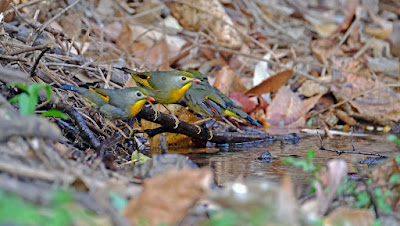
As the sun began to set, I went to Sattal, where in a forest nearby I saw a Brown Wood Owl being mobbed by many lesser birds.  The highlight as always is the “studio”, a small stream near which one can take photographs of birds which come to drink and bathe in the evening.  To aid photographers the forest department has put in a few sticks on which the birds perch before diving into the water.

This Black Bulbul comes in to drink and bathe with a Tickell's Thrush and Red-billed Leothrix awaiting their turn...

...a Himalayan Black-lored Tit looks at me....

...a flock of Red-billed Leothrix get to the water...

...White-crested Laughingthrush drying off after a bath...

...a White-throated Laughingthrush examines me before jumping in.
On the second day being driven I went in search of the elusive Koklass Pheasant, I drove quite a distance and saw one Koklass in the distance. But saw many more butterflies attracted to thistle flowers. Simply being out in the hard and craggy terrain is a joy.

There were clumps of thistles by the road wherever the sun shone, where there were thistle flowers, there was nectar...
... and always butterflies to sip the nectar.

On one of my many walks, I saw Thistle in full bloom by the roadside, and in a first for me, I saw butterflies, Hummingbird Moths and bees attracted by the nectar of these Thistle flowers. Many insects are drawn to these flowers and a lot of clumps by the roadside.

A House Sparrow gets the caterpillar.
There many caterpillars everywhere, of some sort of moth, and though the birds were feeding on them, they didn’t seem to get any less. There were spiders too, big ones and small ones, they made the bedding their home and one had to constantly shoo them away.

Often I would do nothing but sit in the sunshine and watch the world go by. The sunset was particularly beautiful from here.

Sunset in the mountains
Hiking is so universal that it's truly an activity everyone can do. Whether you're young or old, an expert or an amateur, there's a trail out there that will be perfect for you. So the next time you're pondering an outdoor adventure—maybe even reading quotes about camping and think of where you could go, but please leave no trace of your passing.


G.M. Trevelyan

"After a day’s walk, everything has twice its usual value."

John Muir

"Of all the paths you take in life, make sure a few of them are dirt."