![]() |
| A sign at the Entrance to the Valley of Flowers (VoF) says it all The passionate forest guard at the gate told me that he had been scolded by a senior officer that the VoF had no flowers, and that he, the forest guard, should put up a sign warning everyone so. The experience I had was entirely different, I saw a myriad flowers blooming and a tranquil Valley. And I thought to myself that: they are really blind those who will not see. These flowers were very different to to those I had seen on my earlier trip in August 2015, view my photographs of the earlier trip at the link here and my blog of that trip over here |
Showing posts with label flowers. Show all posts
Sunday, 1 July 2018
Who Says There are No Flowers in the Valley of Flowers?
Labels:
blue poppy,
Blue Whistling Thrush,
flowers,
forest,
ghangariya,
griffon,
Hemkund,
Joan Margaret Legge,
mountains,
pika,
Pushpawati River,
Tipra Khark,
valley of Flowers,
variegated laughing thrush
Friday, 20 November 2015
The Trekking Photographer
![]() |
| The Spectacular beauty of the mountains |
Every muscle is straining after six hours of ascent, at 3700 metres my oxygen deprived lungs are gasping, adjusting the seemingly heavy load on my aching back (where did all that extra weight come from?), in a final burst of energy I climb the final slope and in a sudden breath-taking moment a spectacular panorama unfolds, verdant mountains, veiled in clouds surround an icy lake with flowers in profusion. Suddenly months of preparation and the cost of the trip become worth it. After I have absorbed the beauty of what I see, I reach for my camera to record for posterity what the eye and mind sees. This is exactly what I experienced when I trekked to the Valley of Flowers in Northern India earlier this year.

See my earlier blog on the Valley of Flowers on this site and my site on Flickr for photographs for this slice of Gods own corner. Links below:
http://xerxespa.blogspot.in/2015/08/valley-of-flowers-and-hemkund-trek-to_30.html
https://www.flickr.com/photos/129459215@N08/albums/72157657142242599 for VoF pictures and
https://www.flickr.com/photos/129459215@N08/albums/72157657562803801 for the beauty of high altitude flora at Hemkund above 4000 metres. Including pictures of the famed Brahma Kamal.
![]() |
| The famed Brahma Kamal at an altitude of about 4400 metres |
For the entire seven day trek to the Valley of Flowers I
had decided that my primary subject would be flowers and landscape, so I
carried a versatile 18-55 mm zoom with my Fuji XE-1 mirrorless camera and a tripod; keeping it simple I carried no other photography gear. I even left behind my Circular Polaroid filter (CPL), a fact that I regretted as the UV was very sharp at this unpolluted altitude.
![]() |
| the intriguing Bellwort |
Most trekkers I
saw and continue to see on my peregrinations carry inappropriate equipment or are unprepared for these golden moments,
hence bring back mediocre snapshots taken with kilos of expensive
equipment carried laboriously to the top of the mountain. A little forethought
and preparation will enable you to get superb pictures of your treks and
travels.
What to carry
Subject. When you plan your trip,
research and decide what will be your main subject
during the trip. All your equipment must be focussed (pun intended) towards this, camera, lens, flash and tripod. Do not “what if….” every scenario, or you will end up carrying the kitchen sink! I had no long lens, no flash and I never missed them. I have too often seen very enthusiastic but ignorant "photographers" lug huge and heavy equipment (bazooka sized telephoto lens for example), lens wholly ill-suited for the subject contemplated. Their ardour literally crushed by the weight of their equipment. Carrying less weight is very very important, I cannot this emphasise enough. When trekking every tiny item quickly begins to weigh a lot and what should be pleasure soon turns into a very unpleasant experience.
![]() |
| Hemkund Sarovar |
Camera. The
camera is your digital eye and select it carefully well before your trip. Remember
that a couple of hours into a climb, every gram is going to seem like kilos,
weighing heavily on your shoulders. Hence it is vital to carry as light a
camera as possible. Choose between a DSLR or mirrorless (MLC) system (assuming you are an advanced amateur), each has
its advantages and disadvantages, but a MLC is generally substantially lighter
for similar sensor size as most mid-range DSLRs. Prosumers and point and shoot cameras too have their place depending on what you own, can afford, your capability and your potential subject.
The outdoors is rough, dirty, wet and dusty, all serious
enemies of the camera and lens you carry, hence expose your expensive equipment
as little as possible. Avoid changing
lens as an open camera in such an environment can be seriously damaged. Besides, fiddling with lens at critical a time
means you could miss action or fleeting moments. Therefore I recommend the
options are to carry:
- · A prime lens of an optimal focal length for the type of pictures you intend to take. For landscapes and general photography a 35mm to 50mm is suitable.
- · A zoom that covers the possible range you might want, (this is what I did, 18-55mm zoom covered all my needs).
- · Two camera bodies with different lens, (watch your back and shoulders).
![]() |
| A jewel in the flower |
Tripod. There is little point in investing in
expensive equipment, lugging it around and coming back with mediocre unsharp
pictures. For truly tack sharp pics a tripod is vital. Today there are
wonderfully light and compact tripods to suit every pocket and need. Get one. heavier tripods are more stable and light ones easier to carry so it is a trade off. Remember, the heavier your camera the sturdier (heavier) tripod you will need. And don't forget that remote release. Other than when photographing fast moving
birds, I almost always use a tripod.
Minimum
accessories. As I said earlier, every gram will seem a
kilo when it's on your back or around your neck, I have more often than not
seen photographers carry everything they own, camera, lens and flash. Recently
when on a moderate trek, I asked a well-equipped photographer as to why wasn’t
he using a tripod with his lovely long lens, he replied that as it was too
heavy it was in the car and he would get it if required! Of course neither of
us mentioned that his car was a four hour climb away. It is important to
visualize the subjects that one is going to photograph and carry appropriate
equipment for that only. This applies to
all the gear, flash, lens, tripod included. Minimum gear also inculcates a discipline and creativity in doing the most with minimum gear. On the other hand remember that most outdoor locations have limited charging
facilities so always carry spare batteries and memory cards. I generally carry
one extra memory card and two fully charged batteries as spare.
![]() |
| notice my camera rigidly attached to my rucksack strap |
Carry
Rig. Do not for a moment forget that you will be
walking for hours if not days with your equipment. The neck strap that came with the camera is
generally not good enough for this and leaves the camera swinging and your neck
aching. Besides a swinging weight around your neck in rough terrain inhibits movement, leaves you susceptible to injury and your camera to damage. Some intrepid photographers carry bespoke backpacks and pack in
everything photographic they can, leaving little or no room for the other
necessities for a trek. There are many types of bags, backpacks, straps and
harnesses in the market, choose one that’s good for you. Important points to
note are that the equipment should be firmly secured, the load distributed on
shoulders and/or hips (not on the neck as most camera straps facilitate), and
easily accessible. I had my camera in
front, clipped to my backpack strap using a Peak Diamond clip. The same Arca-type plate works for this
bracket and the tripod.
Weatherproof
cover: The weather in the mountains or on a trail can change
rapidly, always carry weatherproof covers for your camera and equipment. Carry
it even if the weather says no rain. If you have to, carry a shelter to change
lens if it is raining. An umbrella or
poncho is better than a rain-jacket for this.
My friend Aarish stocks varied equipment for trekking and carrying equipment and Basav is an expert in equipment and fitness, they have advice for equipment for every level of fitness and type of camera. They would be happy to help and can be contacted below:
aarishsingh @gmail.com
basavm@gmail.com
My friend Aarish stocks varied equipment for trekking and carrying equipment and Basav is an expert in equipment and fitness, they have advice for equipment for every level of fitness and type of camera. They would be happy to help and can be contacted below:
aarishsingh
basavm@gmail.com
What to do
Read the manual and practice. Too many people buy new cameras days before the trek of a lifetime and spend the whole trip figuring out the controls, an expensive lesson indeed. If you don’t want every alternate picture blurred or blank, be smart, read the manual and practice, practice till you can handle most common settings without removing the camera from your eye. Find a similar subject and practice angles, exposure and themes.
Knowledge of the location: Research your intended location from the photography point of view. Know exact times of sunrise and sunset, the morning and evening golden hour in the mountains are spectacular. Know where the photo ops are. Be realistic in your trek timings, factor in the time required to take pictures on the way.
Be fit: Be fully aware of the physical demands of where you intend going and the load you intend carrying. If possible practise a couple of times near your home and see if you are comfortable. For gear on trekking see my blog The Fashionate Trekker at the link below:
http://xerxespa.blogspot.in/2015/08/the-fashionate-trekker.html
Patience is a virtue and make the journey as much fun as
the destination, stop to take pictures, smell the roses and enjoy your trek. Bring back photographs that were a joy to take and more important a joy for others to see.
![]() |
| Majestic Mount Rataban, briefly parting her veil of clouds, seen through the length of the Valley |
Labels:
birds,
Brahma Kamal,
climb,
cold,
equipment,
flowers,
photography,
trekking,
valley,
valley of Flowers
Sunday, 30 August 2015
Valley of Flowers and Hemkund -a Trek to Paradise
Climbing the last kilometer is strenuous, I sweat despite the mild cold, the thin drizzle permeates my clothing with dampness and the wet mud is slippery. As I round a bend in the mountain side rapt in my misery, almost theatrically a wide vista unfolds showing a wide lush green valley with patches of colour and Mount Rataban proudly at its head. It is magical, the tiredness of the climb falls away and the spellbinding view makes the arduous climb of two hours so very worthwhile.
![]() |
| Angelica with cloud veiled mountains in the background |
My trek to the Valley of Flowers (VoF) has been a dream for many years, a dream that I was determined to turn to reality for a week in August 2015. There are many travelogues of ‘how to and where to’ on a trek to VoF so it is not my intention to replicate these. I will put together a kaleidoscope of thoughts and suggestions giving more of a flavor than a guide.
The trip started on Day One on a flight from Mumbai via Delhi to Dehradun and then a taxi to Rishikesh. At Rishikesh I stayed at the Garhwal Mandal Vikas Nigam (GMVN) guest house at Bharat Bhoomi, it is basic but neat, spacious and clean with very friendly staff. That evening I scoured the market for ways to get to Govindghat, I went to two taxi stands and a bus stand. The taxi stands were misleading (and I suspect self servingly dishonest). Quite by accident I discovered two important aspects, one that all visitors to Ghangaria were required to do a photo-registration at a booth near the bus stand, which I did. The second was that there are direct taxis from near the Gurudwara at Rishikesh to Govindghat, I booked myself on one starting at 5 am next morning (Rs 500 a seat). These are shared Tata Sumo with 10 passengers to a taxi which is a seriously tight squeeze, so I purchased an extra seat to make space for myself.
On Day Two our taxi started at 5 am and it was a long, hot, dusty ride along rough roads with few halts, reaching Govindghat at 2.40 pm. Along the way passing through tiny towns which read like the index of a book by the redoubtable Jim Corbett who had shot some of his many man-eaters here, Devprayag, Rudraprayag and Chamoli went by. All along we followed the Alaknanda River till Govindghat. This long taxi journey is perhaps the only tedious part of an otherwise lovely trip. A few kilometers short of Govindghat most network signals cease.
At Govindghat I cast around and found a nice hotel, Bhagat, and prepared for the trek next day. Repacking my day pack for trekking as opposed to travel by air and road, for a guideline of what I carry when I trek, please see my blog here:
![]() |
| Madan, my intrepid porter and I on the way up |
![]() |
| The track going from Govindghat to Ghangaria |
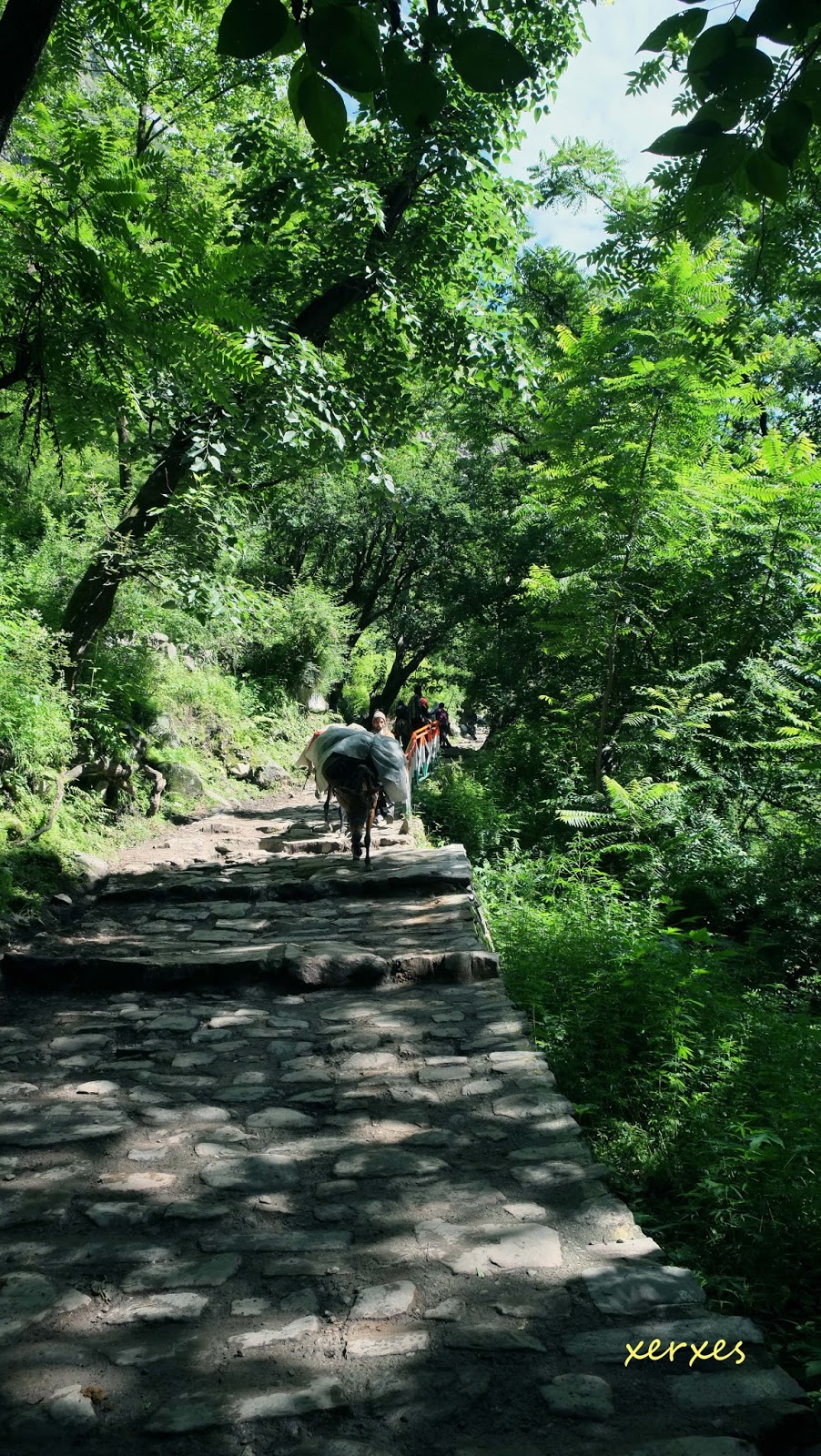
Up early on Day Three, my hotel manager hired a porter for me (Rs 790), he would carry my large pack to Ghangaria. The porter and I walked about 1.5 km down to a bridge on the Lakshman Ganga from where a taxi would take us four km to the start of the trek. I started trekking at 8.20 am along a broad stone path which is undulating in its initial stages till the river bed. Earlier floods had washed away many bridges so the path went across causeways and stony river beds. Being the monsoon, there are beautiful waterfalls on the opposite hillside, including a mighty three stage fall of at least 2 to 300 metres . The path is largely well defined, shady and the walk pleasant. The route has many dhabas and I enjoyed the stuffed paratha and lemon tea, the latter being a very refreshing drink while trekking. After crossing the river, the climb is nearly continuous for about two hours till Ghangaria. There are many people on the route, Sikh pilgrims and tourists giving the place a carnival air. I trekked about 12 km, climbing from about 1800 meters to 3100 meters, reaching at about 2.30 pm.
![]() |
| A la carte - the menu at a decrepit dhaba |
![]() |
| another waterfall along the route |
At 3100m one has entered high altitude and it is important to take sensible precautions in acclimatizing for trekking higher to VoF and Hemkund. Remember that Acute Mountain Sickness (AMS) can kill you or ruin an otherwise lovely trip; on the other hand a few sensible precautions can mitigate the risk considerably. Before starting, have a doctor check you thoroughly to ensure that you are fit enough to undertake such a trek. Then follow an exercise programme a few weeks prior to make sure you are moderately fit to walk and climb at high altitude (there are many programmes on the net).
I did not buy water; instead I used water sterlising tablets the evening before to prepare two litres of water for each day’s trek. I do this whenever I am outdoors as it ensures I don’t have to buy plastic bottled water and so reduce the garbage in ecologically fragile areas.
![]() |
| Panacea for sore muscles at the end of each day |
Here I saw a jarring sign of the “great Indian tourist", the forest department had diverted a mountain stream so that trekkers could fill water bottles. Right next to this someone had left a big, bright blue bar of washing soap, slowly dissolving into the pristine stream. A little further on I saw the shine of silver foil discarded after someone’s breakfast, lying among the flowers. I also met the guide/owner of a very large agency specializing in VoF; he boasted of his 400 GB of photos and his undying love of the Valley, all the while playing loud music on his phone! We are somehow hell-bent on destroying our environmental heritage.
| A list of some of the flowers to be seen at VoF |
The VoF is truly spectacular, cloud veiled mountains stand sentinel around a green and lush valley through which the Pushpavati River flows, this valley in turn is dissected laterally by glacier fed mountain streams; all making for an idyllic scene. There is a stony path made by the forest department which meanders through the vegetation and one gets to see the flowers along this path. One path goes on to Joan Margaret Legge’s Memorial; she was an early pioneer into the Valley and the other path to the end of the Valley.
![]() |
| Joan Margaret Legge's Memorial |
The flowers are spectacular, but I am no authority on flora and much has been written about the flowers in VoF, so I shall not dare tread there. The common plants I saw were Balsam, Angelica, Bladderwort and Large Bellflower among stands of other beautiful flowers. For my pictures please see these links to Flickr:
As is normally the pattern in the mountains, the weather rolled in at about 12.30 pm, clouds roiled up the Valley, wreathing the mountain slopes in white. Shortly it began to rain, almost signaling me to begin my return journey which took about two hours in very slippery slush. I was back in Ghangaria by 4 pm.
![]() |
| Glacier and stream emanating from it in Vof |
Ghangaria is a small town, and most mobile call services do not work here, there is no data service at all, so forget Whatsapp and e-mail. STD booths (I had almost forgotten these!) abound and I got a scratchy connection most evenings. That evening I had a wholesome meal of rice, dal and chapatti in the langar at the Gurudwara. An interesting interlude was that every night a Himalayan black bear with two cubs would come looking for garbage behind the hotels or langar, some people saw them, but I didn’t!
On Day Five I went to the Hemkund Sahib Gurudwara, this is at an altitude of about 4400 meters and I did not feel acclimatised enough to trek up, so I hired a mule (Rs 1150 for the return trip). The trek up can be anything upto 4 – 5 hours, but the mule got me up in about two and a half hours. I started at 6 am and was up by 8.30 am. There was a silver lining to to reaching early; I reached before the clouds descended at about 10 am, giving me ample light to get in some spectacular photographs. The mule driver stops at the mid-way point to give the mules a breather and here I grabbed a paratha and lemon tea for breakfast.
![]() |
| The Sarovar at Hemkund - simply breath-taking |
No description or photographs do justice to Hemkund SahibSarovar, it is breath-takingly beautiful. The Gurudwara is a modern structure (Not very appealing, I prefer the old traditional architecture of Gurudwaras though), however when I went in to mathaa teko (pay obeisance) there was a group of Raagi’s singing followed by the reading of the paath. It was a beautifully calm and serene moment which I sat down to absorb. Next to the Gurudwara is a very old Lakshman Mandir, not as imposing as the Gurudwara, but the panditji had a wonderful charm and it was another very lovely moment.
![]() |
| The Lakshman mandir |
![]() |
| The Gurudwara |
The Sarovar (lake) is truly awe-inspiring, very cold, calm and with the mountains around mirrored in the still water it is a sight to behold. The water is so cold that I could not put my hand in for more than a few seconds without excruciating pain, and here I saw the absolute tolerance faith inspires, an elderly Sikh pilgrim was having an unhurried bath in this icy water!
After enjoying the lake, I trekked up the hillside behind the Gurudwara to see the famed and rare Brahma Kamal flower which was in full bloom.
![]() |
| Emerging from a bath in the icy water |
After enjoying the lake, I trekked up the hillside behind the Gurudwara to see the famed and rare Brahma Kamal flower which was in full bloom.
![]() |
| The famed Brahma Kamal |
That afternoon I joined a birder group walking down about a kilometer towards the helipad where we saw a mixed hunting party of birds. My sightings on the trip included Himalayan Vulture, Large-billed Crow, Oriental Turtle Dove,Wedge-tailed Green Pigeon, Coal Tit, Black Bulbul, Grey-bellied Tesia, Variegated Laughingthrush, Whiskered Yuhina, White-cheeked Nuthatch, Bar-tailed Treecreeper, Blue Whistling Thrush, Grey-headed Canary Flycatcher, Grey Wagtail, Pink-browed Rosefinch (very common), White-winged Grosbeak and Bar-throated Siva.
On Day Six I went again to the VoF, after reading many articles and blogs, I had always wanted to go the the end of the Valley. I made a very early morning start at 6 am in pouring rain but when I was on top by 8 am the rain had miraculously cleared, after a brief stop for breakfast at Shepherd’s Rock, I moved on. Being the first up in the Valley I was rewarded by the sight of a family of Pika playing in a rocky nullah.
As I had vowed not take my camera out till I reached the end of the Valley so as to save time, I managed a couple of pictures on my phone. After walking about four kilometers, the trail tapered off and ended at a river with no visible crossing point. A quick reconnaissance showed an old path across, so I moved on another 3 km along this path, but I could not see the end, so at 1 pm I reluctantly turned back, exiting the VoF park at 5 pm.
![]() |
| The path to the end of the Valley |
As I had vowed not take my camera out till I reached the end of the Valley so as to save time, I managed a couple of pictures on my phone. After walking about four kilometers, the trail tapered off and ended at a river with no visible crossing point. A quick reconnaissance showed an old path across, so I moved on another 3 km along this path, but I could not see the end, so at 1 pm I reluctantly turned back, exiting the VoF park at 5 pm.
![]() |
| The path from Ghangaria to Govindghat |
Day Seven was the day when all good things came to an end, the day of my descent to Govindghat. I had planned to spend the night at Govindghat hence made a late start at 8 am. The same porter I had on the way up came and took my heavier pack as I was trekking with a daypack. It was a pleasant five hour walk down to the taxi stand where I learnt that a landslide had isolated Govindghat from the direction of Joshimath. It was important for me to cross that slide as I had onward reservations from Rishikesh. So, along with a couple of others similarly stranded, I walked another six kilometers to a taxi on the other side of the slide driving as far as Chamoli. The next day it was back to Rishikesh, Delhi and regrettably home.
![]() |
| Memories of Paradise |
Labels:
Brahma Kamal,
flowers,
trek,
valley,
valley of Flowers
Subscribe to:
Posts (Atom)