Showing posts with label homestay. Show all posts

Thursday, 6 April 2017

Parvati Valley - snow clad mountains and smoke


The Parvati Valley
Is one of the lesser known valleys near Kullu, however at the beginning there are prominent places like the hot water springs at Manikaran and Kasol, a smoky destination for the Great Indian Tourist.  The areas served by a road are perpetually full of tourists seeking easy reach and harder stuff.  On the other hand the places where one has to walk to are beautifully calm and isolated. 
A sketch of the Valley
A schematic sketch shows the Burshaini bowl, the road goes upto Tosh whereas the other villages are on foot tracks. If one wants solitude, then walk...  There is a large dam being constructed across the Parvati river at Burshaini, I wonder how this will affect the ecology when this is completed. 

Khalga under snow
I found just the village - Khalga which was off the beaten track. Early March offers a very different experience, it had snowed a day prior to my arrival and a carpet of white covered everything. It was cold, most often bitterly so, and some of the treks I did were in knee deep snow or ice. The head of the Parvati Valley is in a bowl surrounded by snow capped mountains. The bowl has Burshaini and Tosh, both served by roads; and Khalga, Pulga and Tulga, three villages on the mountainside are reached walking.
Every house a homestay or 'guest house'
This seems one of the main sources of income for local people.  In anticipation of the impending season, hectic work was on to clean, refresh or add a room or two to each home stay. The whine of power tools often pierced the tranquillity. A homestay can be a single room with a toilet outside in the snow, toilet down the corridor or an en suite toilet.  The rates for each varied as per the location and conveniences offered.  In the smaller places, like Khalga where I was staying expect to pay about Rs 500 for a very comfortable room and a toilet down the corridor. Homestay owners can get friendly and offer services far beyond what one pays for, and at many locations I saw long term associations where guests kept coming back year after year.


Fickle weather and Fresh Snow
It had snowed heavily just before I arrived and on the drive up the hillside was covered in snow. The weather was as fickle as the people were friendly. Of the six days I was there it rained or snowed on three. Generally the pattern was clear, bright, sunny mornings and wet evenings. The clouds would rise by mid afternoon and rain/snow by evening.


Cafes Everywhere
The season heralds a flurry of activity in preparing cafes, every trail, be it snow bound or the back of beyond, has a cafe. these are ubiquitous huts of wooden skeletons covered in brilliantly covered plastic; these served the mountain cafe staple of 'magi noodles', omelettes
, chips and chai. A menu I have seen almost wherever I have trekked in the mountains. The food here and in homestays is basic but very tasty. In my homestay I made a deal with the host to provide me local food for lunch and dinner.  The menu usually was rajma-chawal, puri-sabji, dal-chappati, with egg bhurji thrown in sometimes to add flavour. Here we see a husband and wife carrying chairs and mattresses to their cafe and the Sun Flower cafe at the start of the Kheerganga climb. Many cafes offer more than food and drink.

Walking in the snow
In the mountains it is wise to spend the first day just getting used to the altitude, walking in the snow and braving the cold. It may not be high altitude, but from sea level (Mumbai) to 3000m in about 24 hours needs reasonable precautions. It had snowed heavily the day before my arrival, and the landscape was shrouded in snow.  The sun is far sharper at this altitude and the reflection from the snow adds to this. I took a guide who knew where to go and the alignment of paths; sometimes ponds and streams are covered in snow and the unwary hiker can end up having a swim at -5°C. 

Icicles on the rocks
It was cold in March, early morning temperature dipping to -5°C or colder.   Each morning when I went out for a walk, the frost would crunch underfoot and the puddles were frozen over. It is important to dress in layers as per dictates of the weather, on any given day I would start out bundled in my warmest wear, gradually removing layer by layer till I was in a single warm T-shirt at midday.  As evening approached I would be in rain gear and clad in my warmest again. The icicles on the way made interesting patterns on the rocks.
Track to the Waterfall
...and on to Kheerganga. There are two routes to Kheerganga, one Khalga-Waterfall-Cafe and Kheerganga and the other Dam-Nagthan village-Rudra Nag Temple-Bridge and on to Kheerganga. I did  not go to Kheerganga as due to the fresh snow and ice, the route was very slippery and I feel, dangerous. So I walked to cafe by one route and returned by another, a hike of about 12 km. The route to the waterfall was snow and ice covered, and the waterfall was frozen, with beautiful icicles suspended from the rocks around. 


Waterfall at Rudra Nag Temple.
I took the Rudra Nag- Nagthan way back from Cafe.  From the cafe the path drops down steeply to the bridge on the Parvati river, a slippery and icy track and shortly thereafter is the Rudra Nag temple with a gushing waterfall nearby. This side of the valley has much less snow and ice, probably due to the increased exposure to the sun.  This is also possibly the reason that it has more population.
 
Children playing at a bonfire at Nagthan
This is a large village on my route back, this route has more ascent and descent than the route out. I had to descend twice to the river and climb up again.  Whereas the route from Khalga was more or less along the same height and more scenic. 
Lady soaking in the sun at Nagthan
as soon as the sun went low, it became cold and everywhere I saw people soaking in the warmth of the last few rays. Nagthan too had its share of homestays, most very basic. If one is to go to Kheerganga it might make sense to stay here the first night.

Mountains around Tosh
Tosh is served by a road and much more on the beaten track. It is a popular weekend destination for young kids from Delhi and Chandigarh, hence it is more touristy, more expensive and does not have much solitude. Booming trance music and smoke emanate from most homestays. It is also the start for the four or five hour Kutla trek, I am told that the high altitude Kutla meadows are tranquil and beautiful, alas I got to know too late and did not go.
Main street Tosh
the melting snow made most paths slushy and wet, particularly if a herd of sheep or cattle had used it. There was mud everywhere and sometimes ankle deep. The village paths everywhere were veritable streams and it was important to have water resistant boots  and carry a spare set of socks all the time.
Snow, solitude and bare trees
March in the Valley is beautiful, the Great indian Tourist is yet to descend in hordes, there is a lovely biting nip in the air, there is solitude to be found off the beaten track 
and the people are not so busy yet and have the time to be friendly.  Bare plum, apricot and apple trees strech their arms out to snow covered mountains over which huge Griffon and Golden eagles soar effortlessly.  

Monday, 13 February 2017

The Colours of Kutch


The vibrant colours of Kutch
A land of colours, craftspeople, history, birds, wildlife and unspoilt scenery. A visit to Kutch enables one to see this and much more, there is something for everyone. The people dress colourfully, and decorate colourfully, thus the craftspeople are skilled and the work everywhere is fine. The course work of cheap commercialism is not yet widespread, but beginning to. This area has, arguably, one of the largest migratory bird populations in the country, this was evident on our trip. The old buildings are redolent in history, but alas like most ancient monuments in the country, it is heartbreaking to see magnificent structures decaying from lack of concern.
Epicentre at Lodhai Village.
This is a wonderful homestay run by Bharat Kapdi, located near a lake at one end of the Banni Grasslands, it has a beautiful view of the surrounding countryside. Named after the devastating earthquake of 2001, one can still see the ravages in the buildings here and elsewhere in the area. Bharat is a great spotter and took us to see many sights both birds and historical.
Spotted Sandgrouse
Bharat took us to see the spotted sandgrouse, a bird seen in India after about 19 years, a beautifully marked bird it is a sight to behold. Bharat's birding knowledge is recent, but the diligence he shows in gathering his knowledge is truly praiseworthy. An absolute master of his area, he knows exactly where to look for what.
Shrujan Museum
This museum is a repository of the exquisite weaving techniques and clothing styles of the nine major clans of the region. The weaves are distinct, intricate, colourful and well documented. Most of the original patterns are breathtaking in their detail. Beautifully built and efficiently run, the museum is a must visit. 
Jaan Mohammed the bell maker
Craft is in the blood of these people, deft with their hands they fashion various artifacts.  These bells are entirely made by hand, so much so that the three pieces that constitute a bell are fused by hammer taps, there is no welding or soldering. He and his family now export bells to the US, giving him new found financial freedom. Their work is so neat and precise besides
they do the tuning entirely by ear, so much so that the bells are a joy to behold and to hear.
Vastness and serenity
The White Rann is but a part of the Great Rann of Kutch, it's vastness is awe-inspiring, so much so that a thousand tourists in a bespoke tourist tower are but a speck in an ocean of white. Salt crystals and water constitute the White Rann, no photograph can do justice to the vast white expanse.  Woe betide the unwary who could sink deep in the slush of salt and water if they are not careful.

Sunset at the White Rann
Children run in the Rann (pardon the pun!) to gain a position of advantage to watch the sunset over the sea of salt.  The crystals are visible, but the water oozing through is not. The Rann Festival is located nearby and it draws tourists from India and abroad. This has resulted in a burgeoning tourist industry of hospitality, shops, camel and horse rides.  The pressure of tourists is already telling on the fragile ecology of the place.
That supercilious knowing look
he knows something that we don't so he peers down at me.  Camels are ubiquitous in this almost desert land, at tourist places, beasts of burden and herds for wool. An entire tribe lives off the camel, drawing all their needs from their herds of camel. But they are also now used to satiate tourists in their perpetual search for the new.


Snacks
The snacks of Kutch are unique in shape and taste. What we would call snacks are served as breakfast and refreshment. Different flavours but generally savory, these bites are served every where. Delicious "farari puri" and "pakwan" are some of the delights served to us in Jaan  Mohammad's hospitality. 
At CEDO
The Centre for Environment, Desert and Ocean run by Jugal Tiwari is interesting in a multifaceted manner.  It is at another end of the Banni Grasslands. A nursery, bird houses, a vast and interesting collection of fossils all go to make up the many passions of its owner. However nothing here is more interesting than the owner, Jugal Tiwari himself. Passionate about what he does, he knows where to go and what to see.  There is a constant flow of guests, birders mainly, both from India and abroad, Jugal has something for everyone, aided ably by his son and brother in law.
Indian Courser
A beautiful bird that Jugal enabled us to see.  His expertise in where to find what is remarkable.  During our travels around CEDO we saw a very wide variety of birds, some of the more rare sightings were: the three types of sandgrouse seen here, a bi-maculate lark, Syke's nightjar, and Red tailed wheatear. 
Than Monastery - beauty of a bygone era
This monastery is now near deserted, but from the beauty of the buildings and opulence of the paintings, it doesn't take much to imagine the buildings in their past glory.  The largesse of the rich formed a large centre of religion.  Today apart from a few temples at the centre, the lovely old buildings are decrepit, occupied by cattle, bats and owls. 
Chari Dhand wetlands
Shallow and flat, these wetlands near Nakhatrana have a beautiful eco-system all their own, with scrub land birds in the dry areas and large numbers of water birds in the lake. This is a favourite destination for serious birders and tourists alike. An ancient volcanic plain, one can still see a mountain said to be a dormant volcano. A sight worth seeing and hearing is the mass movement of thousands of Common Cranes coming in to roost at sunset. Skein after skein, in graceful formation, these cranes come in to the lake.
Lakhpat Fort
The fort has a large area enclosed by its walls, inside which there religious places of Hindus, Muslims and a very revered Gurudwara of the Sikhs.  This fort is along a vast flood plain, with a river leading to the sea.  In the old days this was probably from where trade and access to ports was controlled. 
Flamingos at Mandvi
Mandvi has pristine beaches with a shallow gradient, hence the tide goes out quite a distance.  Fishing boats come in at high tide and are intentionally beached for maintenance, refit and preparation for the next fishing trip. Amongst these boats one sees many Greater Flamingos, gulls, terns and other water birds. At Mandvi creek we saw a great flock of different types of gulls, presumably being fed by someone.  
Sea Captain, ship modeler, raconteur
Shiv Fofindi's family have long been associated with the sea, sailors, fishermen, boat builders and now ship modeler. He has many interesting tales to tell, from his time at sea to his trips to Kailash Mansarover in Tibet and many places between. Here he runs a ship modelling workshop where he trains young people in this intricate and esoteric art of fine detail.

Vijay Vilas Palace at Mandvi
with sprawling grounds and the hint of landscaping, the grandeur of the Maharajas of Kutch is apparent in the now rather decrepit Vijay Vilas  summer palace. It has very fine inlay work, many interesting historical photographs and spectacular views of the area from the roof.  The walls are in decent condition, but the interiors, like many of our palaces, is not in good repair.
Colourful Rocks at the Laiyari River
The Laiyari River bed has some of the most colourful and beautifully shaped rocks I have seen. From bright yellows to deep purple and shades in between, the shapes also lend themselves to flights of imagination.  Please see more of my photographs on Flickr of this lovely place here: The palette of the Laiyari River
Swaminarayan Temple at Bhuj
A gigantic edifice in stark white marble reflecting the midday sun, The temple appears to be an oasis of efficiency.  There are large turrets, columns, intricate work, wide verandahs, accommodation and car parks in this huge area.  The intricate carving is a joy to see as much as is the sheer size of the place.
Pragmahal in Bhuj
Made in the Italian Gothic style of sandstone and marble, the Pragmahal is one of the three palaces clustered in the centre of Bhuj belonging to the erstwhile Maharajas of Kutch. The Pragmahal is said to be the precursor of much of Mumbai's Gothic building style.  The other two palaces, the Aina Mahal and the Old palace are clustered here too.  , These palaces are sad relics  of the bygone 
grandeur of the Maharajas, priceless artifacts have either been stolen or dumped without maintenance. 
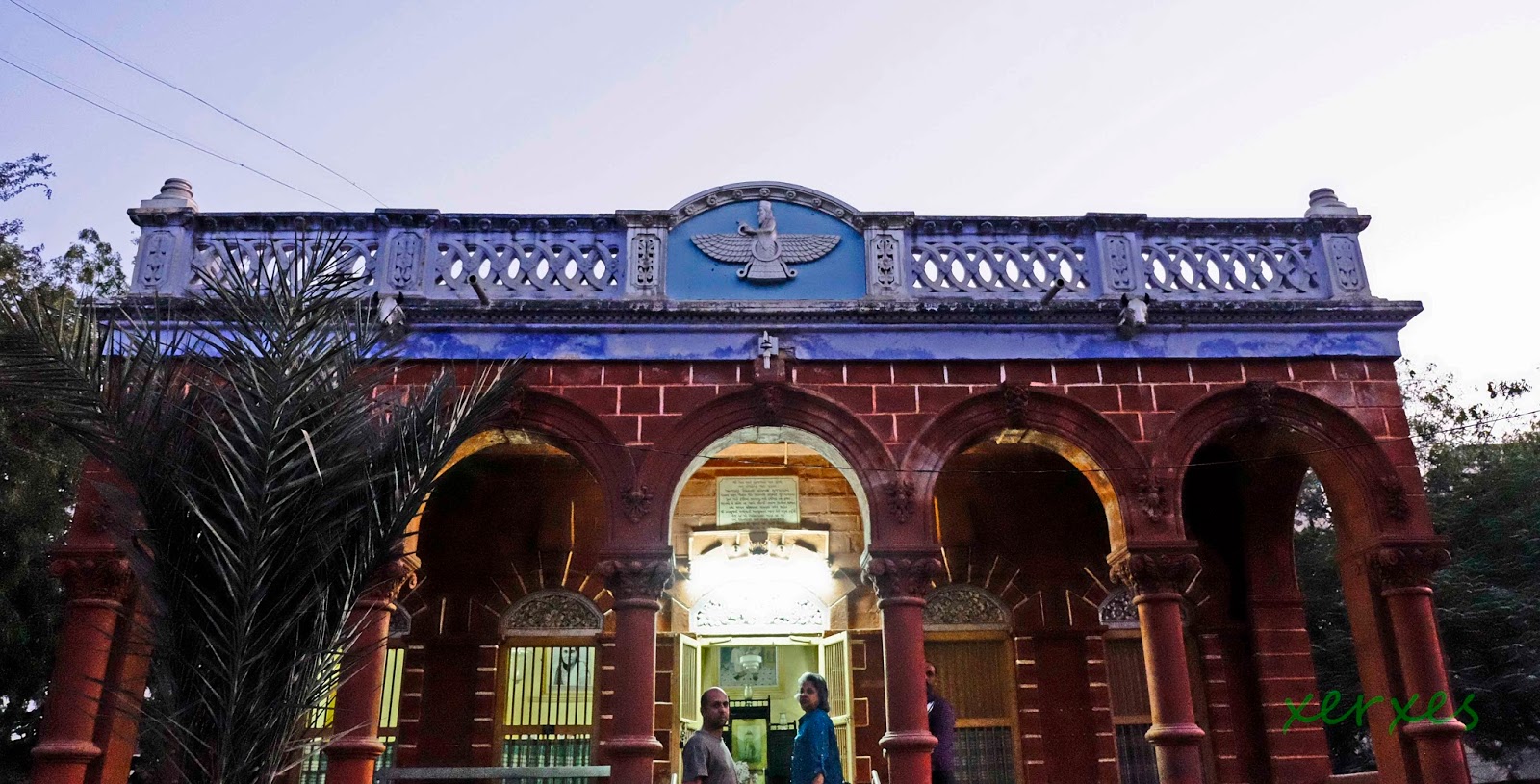
The Agiary
Bhuj once had a very large Parsi Zoroastrian population, but time and opportunity elsewhere have whittled the Parsi population down to a single family.  The Agiary is no longer a functioning one, but the family tries to generate funds and maintain the Agiary.
To me Bhuj is a land of colour, there is colour everywhere, in nature and in the people. The birds, trees and rocks are colourful; the people have developed colourful weaving styles and colourful clothes.  It refreshingly has relatively fewer tourists, but The Great Indian Tourist is getting there and signs of his depredations are visible now.  Enjoy this land of colour before it is whitewashed to conform to the needs of tourism.