Monday, 13 February 2017

The Colours of Kutch


The vibrant colours of Kutch
A land of colours, craftspeople, history, birds, wildlife and unspoilt scenery. A visit to Kutch enables one to see this and much more, there is something for everyone. The people dress colourfully, and decorate colourfully, thus the craftspeople are skilled and the work everywhere is fine. The course work of cheap commercialism is not yet widespread, but beginning to. This area has, arguably, one of the largest migratory bird populations in the country, this was evident on our trip. The old buildings are redolent in history, but alas like most ancient monuments in the country, it is heartbreaking to see magnificent structures decaying from lack of concern.
Epicentre at Lodhai Village.
This is a wonderful homestay run by Bharat Kapdi, located near a lake at one end of the Banni Grasslands, it has a beautiful view of the surrounding countryside. Named after the devastating earthquake of 2001, one can still see the ravages in the buildings here and elsewhere in the area. Bharat is a great spotter and took us to see many sights both birds and historical.
Spotted Sandgrouse
Bharat took us to see the spotted sandgrouse, a bird seen in India after about 19 years, a beautifully marked bird it is a sight to behold. Bharat's birding knowledge is recent, but the diligence he shows in gathering his knowledge is truly praiseworthy. An absolute master of his area, he knows exactly where to look for what.
Shrujan Museum
This museum is a repository of the exquisite weaving techniques and clothing styles of the nine major clans of the region. The weaves are distinct, intricate, colourful and well documented. Most of the original patterns are breathtaking in their detail. Beautifully built and efficiently run, the museum is a must visit. 
Jaan Mohammed the bell maker
Craft is in the blood of these people, deft with their hands they fashion various artifacts.  These bells are entirely made by hand, so much so that the three pieces that constitute a bell are fused by hammer taps, there is no welding or soldering. He and his family now export bells to the US, giving him new found financial freedom. Their work is so neat and precise besides
they do the tuning entirely by ear, so much so that the bells are a joy to behold and to hear.
Vastness and serenity
The White Rann is but a part of the Great Rann of Kutch, it's vastness is awe-inspiring, so much so that a thousand tourists in a bespoke tourist tower are but a speck in an ocean of white. Salt crystals and water constitute the White Rann, no photograph can do justice to the vast white expanse.  Woe betide the unwary who could sink deep in the slush of salt and water if they are not careful.

Sunset at the White Rann
Children run in the Rann (pardon the pun!) to gain a position of advantage to watch the sunset over the sea of salt.  The crystals are visible, but the water oozing through is not. The Rann Festival is located nearby and it draws tourists from India and abroad. This has resulted in a burgeoning tourist industry of hospitality, shops, camel and horse rides.  The pressure of tourists is already telling on the fragile ecology of the place.
That supercilious knowing look
he knows something that we don't so he peers down at me.  Camels are ubiquitous in this almost desert land, at tourist places, beasts of burden and herds for wool. An entire tribe lives off the camel, drawing all their needs from their herds of camel. But they are also now used to satiate tourists in their perpetual search for the new.


Snacks
The snacks of Kutch are unique in shape and taste. What we would call snacks are served as breakfast and refreshment. Different flavours but generally savory, these bites are served every where. Delicious "farari puri" and "pakwan" are some of the delights served to us in Jaan  Mohammad's hospitality. 
At CEDO
The Centre for Environment, Desert and Ocean run by Jugal Tiwari is interesting in a multifaceted manner.  It is at another end of the Banni Grasslands. A nursery, bird houses, a vast and interesting collection of fossils all go to make up the many passions of its owner. However nothing here is more interesting than the owner, Jugal Tiwari himself. Passionate about what he does, he knows where to go and what to see.  There is a constant flow of guests, birders mainly, both from India and abroad, Jugal has something for everyone, aided ably by his son and brother in law.
Indian Courser
A beautiful bird that Jugal enabled us to see.  His expertise in where to find what is remarkable.  During our travels around CEDO we saw a very wide variety of birds, some of the more rare sightings were: the three types of sandgrouse seen here, a bi-maculate lark, Syke's nightjar, and Red tailed wheatear. 
Than Monastery - beauty of a bygone era
This monastery is now near deserted, but from the beauty of the buildings and opulence of the paintings, it doesn't take much to imagine the buildings in their past glory.  The largesse of the rich formed a large centre of religion.  Today apart from a few temples at the centre, the lovely old buildings are decrepit, occupied by cattle, bats and owls. 
Chari Dhand wetlands
Shallow and flat, these wetlands near Nakhatrana have a beautiful eco-system all their own, with scrub land birds in the dry areas and large numbers of water birds in the lake. This is a favourite destination for serious birders and tourists alike. An ancient volcanic plain, one can still see a mountain said to be a dormant volcano. A sight worth seeing and hearing is the mass movement of thousands of Common Cranes coming in to roost at sunset. Skein after skein, in graceful formation, these cranes come in to the lake.
Lakhpat Fort
The fort has a large area enclosed by its walls, inside which there religious places of Hindus, Muslims and a very revered Gurudwara of the Sikhs.  This fort is along a vast flood plain, with a river leading to the sea.  In the old days this was probably from where trade and access to ports was controlled. 
Flamingos at Mandvi
Mandvi has pristine beaches with a shallow gradient, hence the tide goes out quite a distance.  Fishing boats come in at high tide and are intentionally beached for maintenance, refit and preparation for the next fishing trip. Amongst these boats one sees many Greater Flamingos, gulls, terns and other water birds. At Mandvi creek we saw a great flock of different types of gulls, presumably being fed by someone.  
Sea Captain, ship modeler, raconteur
Shiv Fofindi's family have long been associated with the sea, sailors, fishermen, boat builders and now ship modeler. He has many interesting tales to tell, from his time at sea to his trips to Kailash Mansarover in Tibet and many places between. Here he runs a ship modelling workshop where he trains young people in this intricate and esoteric art of fine detail.

Vijay Vilas Palace at Mandvi
with sprawling grounds and the hint of landscaping, the grandeur of the Maharajas of Kutch is apparent in the now rather decrepit Vijay Vilas  summer palace. It has very fine inlay work, many interesting historical photographs and spectacular views of the area from the roof.  The walls are in decent condition, but the interiors, like many of our palaces, is not in good repair.
Colourful Rocks at the Laiyari River
The Laiyari River bed has some of the most colourful and beautifully shaped rocks I have seen. From bright yellows to deep purple and shades in between, the shapes also lend themselves to flights of imagination.  Please see more of my photographs on Flickr of this lovely place here: The palette of the Laiyari River
Swaminarayan Temple at Bhuj
A gigantic edifice in stark white marble reflecting the midday sun, The temple appears to be an oasis of efficiency.  There are large turrets, columns, intricate work, wide verandahs, accommodation and car parks in this huge area.  The intricate carving is a joy to see as much as is the sheer size of the place.
Pragmahal in Bhuj
Made in the Italian Gothic style of sandstone and marble, the Pragmahal is one of the three palaces clustered in the centre of Bhuj belonging to the erstwhile Maharajas of Kutch. The Pragmahal is said to be the precursor of much of Mumbai's Gothic building style.  The other two palaces, the Aina Mahal and the Old palace are clustered here too.  , These palaces are sad relics  of the bygone 
grandeur of the Maharajas, priceless artifacts have either been stolen or dumped without maintenance. 
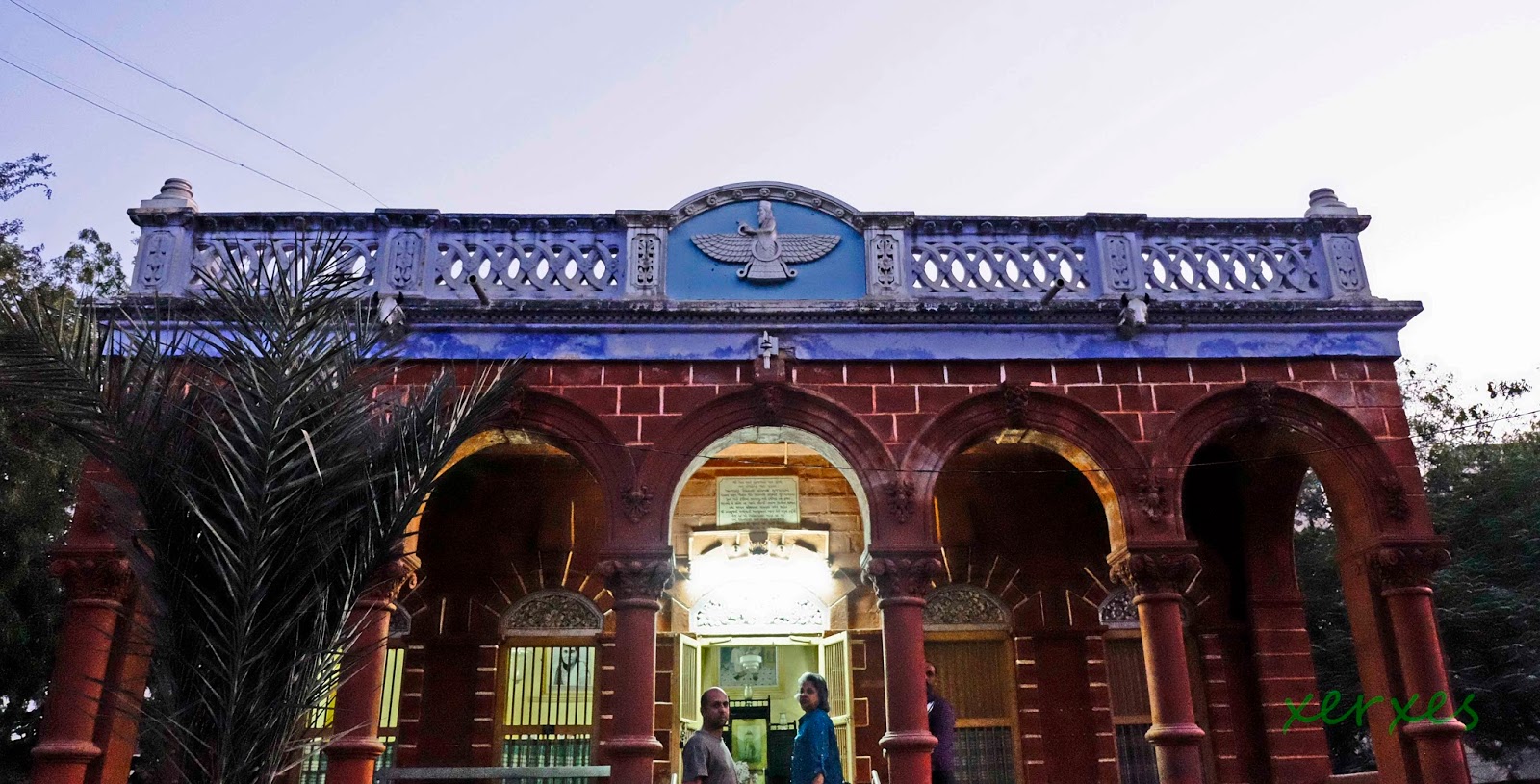
The Agiary
Bhuj once had a very large Parsi Zoroastrian population, but time and opportunity elsewhere have whittled the Parsi population down to a single family.  The Agiary is no longer a functioning one, but the family tries to generate funds and maintain the Agiary.
To me Bhuj is a land of colour, there is colour everywhere, in nature and in the people. The birds, trees and rocks are colourful; the people have developed colourful weaving styles and colourful clothes.  It refreshingly has relatively fewer tourists, but The Great Indian Tourist is getting there and signs of his depredations are visible now.  Enjoy this land of colour before it is whitewashed to conform to the needs of tourism.

Tuesday, 24 January 2017

Karnala - Thumbs Up to the Nature World


Beacon to nature lovers and trekkers far and wide.
Located just off the National Highway Mumbai-Goa, the central basalt rock pillar of Karnala Fort, often referred to as 'Pandu's Tower', is visible from great distances. I saw it close while up in the air flying by in a helicopter, picture here. It was then I decided to climb the fort.

An encouraging 'Thumbs Up' 
Generally built on two levels, the landmark pillar is at the higher level of the fort which is at a strategic location guarding the Bor Pass.  It has changed hands many times and Marathas, Portuguese and the British have all in turn held this important fort. Today it is far more peaceful, beckoning birders, walkers and picknickers from afar.  There are two distinct aspects to Karnala, a climb to the fort itself and nature trails in the forests around.


The Climb
The trek to the fort starts at the forest office complex inside the park gates. It is about an hour's moderately stiff climb for the fit, an hour and a half for couch potatoes like me. Initially it is a vertical climb along a clearly discernable but very uneven path consisting of  steep steps, roots and boulders.  The walk is through thick forest in the lower reaches, part of the bird sanctuary where one sees a variety of birds and troops of langurs and macaques. 

Along the Ridge
After climbing uphill for a while, one reaches a pass, where the path turns right along the ridge to the north of the fort. The wily builders to the fort had ensured just one approach along a narrow ridge, this ensured that the attacker could not concentrate sufficient  troops to storm the fort, making it easier to defend.
Approaching the fort
The ridge is about a kilometre long, with beautiful views on both sides. While walking towards the fort one can see the dense forest of the sanctuary on the west (right) and the Patalganga river in the distance to the east (left). The path is not in good repair and large parts are cross-country rough terrain. The vegetation to both sides of the path has been burn by the forest department to 'manage' the growth.
Calotes
This calotes tries escaping the heat of the burning vegetation.
The forest department takes great 'trouble' to keep the path clear, I saw an official, supervising a gang of labour who simply burnt the grass and small vegetation on the sides of the path.  Ever wonder why there is a constant haze everywhere?  This random burning doesn't care for the little animals and insects that are killed, the large living trees that are burnt and of course the possibility of the fire spreading.
At the main level
There are walls that denote structures of yore, but these seem more European in shape, possibly added on later by the Portuguese or British. The stories these stones could tell if they could talk!  These could be barracks for the defenders or powder magazines for the cannons.  The cannons deployed here could not have been very large as there seems to be no large path to get them up, also as is evident from the small embrasures in the walls.
An empty gate stares
Flanked by two trees, an empty gate opens out to what may have been the main approach to the citadel. There appears to be signs of a larger path below it, now unusable. Behind the gate are rock-cut cisterns.  Water was the lifeblood of these forts, and they had to have a sufficient stock of water to withstand long sieges of months or even years. These cisterns were rain fed or filled by springs.
Stairs to a lookout
These stairs go to a lookout at one end of the fort, there is a steep unguarded drop on either side. Most forts such as these based their defences on inaccessibility, the more difficult to climb or gather large forces, the easier to defend. So often the attacker had only one recourse, the siege, these lasted months or even years. 
Karnala Bird Sanctuary
The eponymous bird sanctuary, surrounds the base of the fort. The slopes are thickly wooded, providing residence to a variety of birds, insects and mammals. An early morning walk along the trails is a rewarding one, allowing glimpses of the denizens going about their daily lives.  Beware weekends, as a little later in the day, a very destructive species of the Great Indian Picnicker strikes these cool and silent forests. Throwing thermocole plates with gay abandon and catcalling, they quickly destroy the environment and solitude of these wondrous forests.
Forest Trails
There are many trails in the forest of the sanctuary, the longest takes about an hour of slow walking. One can combine trails, switch trails midway or do them sequentially. Some trails have grasslands and most have forests astride them.  Besides the ever present macaques and langurs, one can see a variety of birds and insects depending on the season.
Sunrise
My favourite time in the forest is when the sun rises, actually the sun rises behind the fort hence becomes visible in the sanctuary to the west much later. The rays are highlighted by the smoky haze of early morning inversion.  The effect is ethereal. 
Drop of gold
The sun backlights this dewdrop, the drop is so clear that it acts as a lens, reflecting the forest behind it. 
As the rays peep over the fort, they slowly percolate the forest canopy, warming plants, insects and birds. The best time to photograph insects is when they are slow before being warmed by the sun.
Breakfast
This is one of the best times to see birds as well as they are busy in their early morning feed or on tops of trees soaking in the sun. Here is a green bee-eater with a tasty grasshopper morsel. Behind is a sunbird, well ... sunning itself!
Salmon Arab Butterfly
Butterflies are plentiful, and as it gets warmer, they get more active, so go early for good pictures. On my many walks here, I have seen some amazing sights real close. It is nice to see the serious effort put in by the forest department in preventing litter  I hope it is not a losing battle, as unless we discipline ourselves, we shall end up neck deep in a pile of paper plates and plastic bottles.  Worse, I have seen birds snared in plastic bags and people feeding monkeys non-monkey food.
Lemon Pansy
I recommend spend a day going up to the fort and another half day walking the trails.  each has a lot to offer.  Don't miss breakfast and lunch at the little cafe inside the park, run as a cooperative by local ladies, they offer veg and non-veg food, both delectable.  The glutton in me orders the non-veg thali accompanied by the vegetable of the day, getting the best of both worlds. 
Spending a day or two, specially mid-week, in and around Karnala is a true communion with nature. 

Tuesday, 6 December 2016

Central India- Tales These Stones Tell


Central India - the melting pot of Indian history.
 The stones at Jhansi, Orchha, Khajuraho and  Gwalior all have a story to tell. So many stories in fact, spanning centuries, tales of love, religion and of course war. There are monuments to each of these fundamental human passions at these places. It is nice to see that the monuments are very organised, clean and well maintained, a pleasure to visit. There is much written about these places hence this is not a tourist guide or travelogue, just a peep into history through my lens.
Jhansi Fort
My travels began at Jhansi Fort. It is redolent of history, of course the famous Lakshmibai, Rani of Jhansi fought for her rights here. Immortalised in the poem:

 "Bundeley Harbolon key munh hamney suni kahani thi,
Khoob ladi mardani woh to Jhansi wali Rani thi."
These walls were witness to to so much valour, defiance and grief, if only they could talk.
War and Religion
Warriors are religious and in almost every fort anywhere in the world one finds a place of worship.  Here a temple is seen through the crenellation of the fort wall. Forts were self contained units often encompassing the entire city at that time, and Jhansi is no exception. Such city forts had palaces, bazaars, residences of important people, royal stores and of course places of worship. One such temple is seen through the crenellations of the fort walls.
Stairs to the Gun Emplacements
The history of Jhansi has been colourful and almost the entirely centred around the fort.  The construction has been altered through the ages keeping pace with advances in armaments and tactics.  It is curious to see machine gun emplacements in the walls and since machine guns are a late 18th Century invention, these couldn't have been made during the First War of Independance of 1857 (or Mutiny, depending which side one is on) as the guide explained.  At some period, possibly between the two World wars, this must have been a prison hence the machine guns.  I have not seen machine gun emplacements at any of the other Indian forts I have visited.
Orchha
Palaces, temples and Royal Chattris (mausoleums) abound in this jewel on the banks of the Betwa river, about 15 km from Jhansi. Created by the Bundela kings, subsequent rulers added to the grandeur as indicated by the varied architectural styles. The history of these sites and the origins of the people who ruled at various times is evident in the style of the buildings. 
Royal Chhatris by the Betwa River
A striking feature of Orchha are the Royal Chhatris by the banks of the Betwa.  Made in very different shapes and sizes, they were built as memorials to royalty cremated here through the ages. It is worth crossing the river before sunrise and watch the early morning rays illuminate the Royal Chhatris across the Betwa. 
Bathing on the Ghats
This ghat remains holy and at sunrise many people come down to the ghats by the Chhatris to bathe. If only I could wash my sins off so easily!! There are convenient ghats made along the river bank here separately for men and women.  However gradually many of the ancient ghats have been taken over by the ubiquitous resorts built by the river. Considering the pressure of population coming to worship here, the place is remarkably clean.
Indian Vulture
The monuments at Orchha are home to a large flock of Indian Vulture, a majestic and huge bird which one seldom gets to see this close. There is an active protection program for these birds which breed here unhindered. Sign boards in Hindi and English outline the program. I wonder how the interaction of caustic droppings from endangered birds on centuries old 
fragile stone carvings is going to pan out? A present symbiosis of the old and the endangered may result in a future confrontation?

Nesting
The vultures were nesting when I was there, making large nests inside the old palaces and chhatris. The birds also seem to have perfected the art of sitting on an acutely slanted roof.  Here is a bird carrying twigs to its nest in the monuments.  The huge, over six foot, wing span is visible clearly.

Lakshman Temple at Khajuraho
Enough and more has been written about the famous temples at Khajuraho. The area of the main site is relatively small, and depending on how long one takes at various locations, it should take about two to two and a half hours to see the entire group.  My only two observations are, firstly the "erotic" sculptures are few and in a setting of social requirement of the time. There is nothing lewd nor are they as prolific as the media and pamphlets would have us believe.  And......


...I was speechless at the proportion, detail and scale of the temples. The ancient stone craftsmen were consummate, using mathematical proportion and size to achieve eye-catching grandeur. The detailed carving is always at visible distance, after that repetitive pattern; both of these harmonise into a pleasing whole.  The detail is incredible, as is the number of centuries that these have stood. Truly a heavenly spectacle.
Man Mandir or Man Singh Palace
This is the citadel of the main fort at Gwalior. The fort changed hands and purposes through the centuries, this is reflected in the eclectic architecture and sprawl of the walls. At various times it has resonated to the sounds of battle at the fort walls; a centre for performing arts, the Gwalior gharana  is one of the oldest Khyal Gharanas and flourished under the patronage of Akbar and his  favorite singers including the famous Miyan Tansen ;  a palace,  and the agonised groans of the political prisoners of a grim prison. The sound and light show is very well done and explains the history of the fort through the ages.  
Gurdwara Data Bandi Chorh Sahib
Guru Hargobind was a prisoner in this fort and legend has it that on his release he obtained the freedom of 52 other prisoners with him. This Gurudwara and many other monuments exist within the fort walls. Some of the temples like Teli ka Mandir and Sahas-Bahu have exquisite stone carvings and command an imposing view of the city around. Very large and extensive Jain rock carvings line the route to the fort.  
Part of the fort is occupied by the Scindia School.
The Moon rises above Orchha
The moon and the sun have risen and set many times over this crossroads of Indian history, ancient Rajput kings, Marathas, Mughals and the British have all struggled for dominance briefly, leaving their marks on the pages of history.  These stones have seen in turn war and peace, hardship and prosperity, music and anguished groans.
If only they could tell us what they saw.