Showing posts with label Bharatpur. Show all posts

Monday, 30 May 2022

Bharatpur: A Birders Paradise


“Photography is the story I fail to put into words.”

– Destin Sparks

In order to see birds, it is necessary to become part of the silence.”

-Robert Lynd 

A tranquil part of the Sanctuary
Birds, birds birds, the Bharatpur Bird Sanctuary is simply full of them, and going there on a weekday is that much more calm and serene.  

Telling each other secrets A pair of Rose-ringed Parakeets go about their circle of life while we look on...
A Grey Heron dries its feathers
Birds are one of the sure indicators of the environment, if they are in trouble, we know we’ll soon be in trouble. To see the one of largest gathering of migratory and resident birds in India, I went to Bharatpur Bird Sanctuary in the winter of this year. The Sanctuary is and was known by different names, but I like Bharatpur Bird Sanctuary and I shall call it variations of that.

A Black-winged Stilt contemplates its reflection in the small pool behind where I was staying
A long but lovely train ride from Mumbai deposited me the next midday at Bharatpur, it was too late to go to the Bird Sanctuary, so I did some local birding around the place I was staying.

Sarson (mustard) flowers everywhere one could see
It was lovely, the quiet and sounds of village life, of course punctuated by the electronic blare of modern times. At this time the fields were planted with sarso (mustard) and the yellow flowers of the ripening crop was like a carpet as far as eye could see.

A Grey Wagtail sits onthe rocks  in the village pond.
Over the next three days I took a guide (one day) and one of the ubiquitous cycle rickshaws, the same rickshaw person became my friend and guide, and we went around various parts of the park over three days.
one of the many rickshaws going along the trails that divide the wetland
At this time of year there are many birds and animals, many of them breeding and the young, like that of humans, are either raucous or quiet, shy or aggressive.  Each of them engrossed in the circle of life that perpetuates the type.

A family of Painted Stork with the parents feeding the chicks. The noise is deafening.

A Painted Stork chick comes for a closer look.  It has been dipping its hurt beak into the water..

Scratching that infernal itch
Not long ago this was the private hunting reserve of the British and the Maharajas, stone tablets bear mute testimony to the terrible slaughter that took place here each year. Then in recent years, sadly the Sanctuary was the pawn in the power play of politics. For now, all is well.
One of the stone tablets which proudly displays the slaughter of years past
For those that haven’t been there, Bharatpur is a series of large swamps with trails crisscrossing. Algae covers the swamp, in hues of bright green or rust red and the birds feed on these algae or the fish that live here. It seems that various types of large birds have proprietary rights over different parts of the swamps and the trees growing in the midst of these wetlands.

A flock of Bar-headed Geese drink water...

...this Eagle is the master of all he surveys
This part of Bharatpur city thrives on birds, at the place where I stayed, the owner proudly showed me a family of owls breeding on his property. On the day I arrived since I was too late to go to the Bird sanctuary, I went for a walk near the village behind where I was staying and birds went undisturbed about their business.

An Owl shuts its eyes against the glare of the day

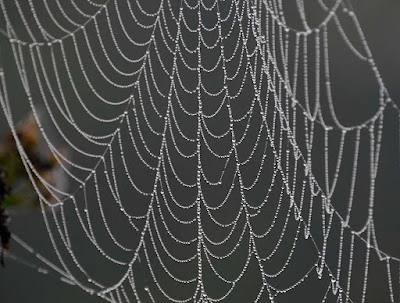
Dew makes this spider's web a necklace fit for a queen
There are many animals too in this Park, nilgai, boar, jackal and much to my delight, a family of porcupines.  Of course the Indian Rock Python is ubiquitous, this being a favourite place to spot them.

Indian Rock Python basks in the fading sun.
The emblem of the sanctuary and often spotted here are the Sarus Crane, there are many stories about them, some true and some not so true, nevertheless seeing these huge birds is fascinating. Then there are migrating and resident ducks, geese, coots and a variety of smaller water birds, each busy feeding on the rich nutrients the swampland has to offer.

A Brown Shrike looks out for a juicy morsel in the air.....

...while this Egret has caught a fish swimming below the rust brown algae
Great White Pelicans seem to be master tacticians, they form a flock and corner the fish, then each diving in to catch what it can. Just watching them sail majestically to and fro is a delight.  Then suddenly there is a flurry of frantic activity as these huge birds dive in to catch what they have cornered.At sunset, skeins of these huge birds fly off to roost.

Great White Pelicans form a flock to fish...

.....At dusk these huge birds fly off to roost

It is a photographer’s paradise, sit still or move around, do both sometimes, there is much to be seen and images made of. The park closes after sunset, so watching the sun go down each day is particularly beautiful, the water takes on a golden hue and birds feed well into the darkness.

Dusk at the Sanctuary, but an Egret looks for fish.....
 
The sun goes down among the trees, and so the circle of life goes on.
Every bird, every tree, every flower reminds me what a blessing and privilege it is just to be alive and go to places like these.

Thursday, 23 July 2015

Bharatpur Keladeo National Park – A Tail of Birds?


Tranquility
Swirling fog, reflections of bare trees in the water, the cry of birds in the distance, placid Nilgai and Chital feeding in the swamp, a lonely Indian Rock Python by the side of the road; all haunting images of a beautiful bird sanctuary. This placid and almost utopian image was shattered by gunfire in the past and today by loud music, groups of people drowning out the jabber of jungle babblers with human cacophony; the careless flick of a tourist wrist throwing a plastic wrapper destined to choke an unwary bird to a very unpleasant death.  Jungle Babblers and Indian Magpie beg the passerby for a morsel, having lost the art of foraging as they've grown used to eating 'fast food' thrown at them by visitors. On a holiday it is obvious that most people come here to see and do everything except watch the birds or enjoy the placidity of nature. I saw couples and groups, most here just for the sake of being here, "Bharatpur dekha". 


Jungle Babbler begging tourists for food
Very few were intent on watching the birds or respecting the serene calm of the environment, most were rapt in their own social cocoons with a couldn’t care attitude to all else.  Humankind’s irrevocable carelessness to nature has been commonplace at Bharatpur ever since birds found it a convenient place to stop and recoup on their migrations. 

As Hubert Reeves put it:
"Man is the most insane species. He worships an invisible God and slaughters a visible Nature....
Without realising that this visible Nature he slaughters is the invisible God he worships."

A pair of Sarus Cranes and a Nilgai in the background
The slaughter began in the days of the maharajas and 'burra white sahibs', the tally of death being graven in stone beginning December 1902. Stone plaques proudly list the slaughter, in thousands. Battalions of men and women, decked out in sola topees and coiffed hair, carrying bespoke guns, descended on the unsuspecting birds and slaughtered them for sport. There were British royalty, maharajas, viceroys, generals and colonels, and sometimes just the plain old 'Mr'. Each of these was a 'gun' in a shooting party which blasted away at anything that flew, the unfortunate bedraggled bundle of dead feathers being the 'bag'. The magnitude of this slaughter decimated the bird population by the thousands. Apart from the bloodletting, the birds fearing danger, would have started avoiding the area in their migratory path.  This resulted in a drastic reduction of bird population and the possible avoidance by the migratory birds of an area bristling with guns.  This had an effect, the stone tablets showing the bag in the Park generally indicate an increase in guns and reduction in the birds killed as the years passed. 
One of the stone plaques giving a tally of  the massacre
 However, in 1936 the apparently intrepid Lord Linlithgow, Viceroy of India, with a party of 39 guns bagged 4273 birds on one occasion and about 5500 birds on three other shoots. Ten thousand birds in a few months, what could they have done with so much dead flesh? Eaten a morsel, fed some to the 'native' staff, and finally fed the dogs the rest?  What sport, a true sign of macho manhood indeed!  One needs to read old accounts of such hunts to understand the hardships that the hunters faced in their warm hides with multi-course breakfasts; shooting the unwary bird between sips of premium tea. Most Maharajas curried favour with the British bureaucracy by enabling grand hunts in their kingdoms, the greater the slaughter the higher the esteem in which the Maharaja was held.  Jolly good show, what?

purple heron taking to the air
The almost active attempt to reduce bird migrations has continued since, despite the Keoladeo National Park (KNP) being declared a Ramsar site due for the protection that this convention affords.  Chronic water shortages have further reduced the size of the wetlands so essential for migratory birds; the dry politics of water have kept birds away.  When I visited the Park in 2007 it was a dry wasteland, with a few bore wells desultorily pumping water into the parched earth.  I saw a large population of feral cattle vying with the wildlife of the Park for the scarce water and feed.  Again in 2015, I went there and was disappointed with the number and type of bird sightings, most of the big birds, cranes and storks, were conspicuous by their absence.


The king and his courtiers.... a Great Egret, Ibis
and whistling teal
 The permitted modes of movement in the park are on foot, bicycle and cycle-rickshaw.  The cycle-rickshaw peddlers most often double as guides with long and detailed lore of the park. My guide had peddled a rickshaw in the Park for about 20 years and his earnings over a six month season was his only livelihood as was that of most of the other peddlers. He said he is nervous about his own survival which is linked to survival of the park. He told me that the water being pumped in was being filtered so as to prevent the pumps from clogging and this filtration process removed natural food from the water and so was not attracting birds any more. There was a time, till recently, when these birds used to regularly nest here, they do so only sporadically now.

A crested serpent eagle surveys his domain
And of course the great Indian Tourist finishes off what little the Maharajas and water politics have left us. Large groups come to see KNP, they do just that, enter the Park, yell and shout, feed the birds with a lot of unhealthy fried foods, spray plastic wrappers and bottles everywhere and leave.  Ramsar? Conservation? Ecology?  What's that and anyway who cares, we are having great fun. Rickshaw peddlers, who depend on the park for a livelihood, try unsuccessfully to quell the noise and litter. These rickshaw peddlers are truly the conscience of the Park, when they are gone, all will be lost. I saw two adult visitors having a whistling contest at the waters edge!
an Indian Rock Python

If we continue on this trajectory, in a few years there will be no birds worth seeing. We have the scope and time to turn this around but draconian measures are called for if we are not to lose this site.  As I walk out of the Park along a plastic wrapper and bottle strewn path I wonder if this will be my last trip here. It is still not too late to save the tranquil stillness, the cry of a bird in the distance, a flurry of wings, and to worship nature in one of the few temples we have left.